What RCE Risk Actually Means for AI Sandbox Design
Prompt injection now gives attackers a direct path to remote code execution inside AI agent systems.
Microsoft's own Defender Security Research team built a hotel booking agent, fed it one crafted sentence, and it launched calc.exe on the host machine. The entire piece covers what that demonstration means for how AI sandboxes get designed, because the vulnerability it exposed is not a bug in one framework but a structural property of how modern agents are built.
RCE in AI agent systems is no longer a network perimeter problem
Remote code execution in an AI agent system does not start at the firewall, the WAF, or the network edge, the places where security teams have spent two decades building defenses. It starts inside the agent's own execution loop, at the exact point where prompt-controlled logic reaches a code evaluation path. Microsoft's Defender Security Research team described the structural problem in direct terms: once a model is wired to tools, prompt injection becomes a code execution primitive, and a flaw in that wiring carries systemic risk across every deployment built on it. The mechanism they demonstrated required no exotic exploit chain. A crafted prompt shaped a tool's parameters, those parameters went through unsafe evaluation, and what came out was code execution with the privileges of the host process.
Earlier generations of AI systems produced text. Agents are different by design: they read files, run scripts, query databases, and call external services on a user's behalf, which makes the AI layer itself an execution layer. A vulnerability in that layer is an execution risk, with the same consequences as a flaw in any other piece of system software that runs with real permissions.
This matters for defenders because every control built for the old threat model assumes the attacker is outside the system trying to get in. The perimeter holds. The attacker never needed to cross it.
How the prompt-injection-to-RCE chain executes in practice
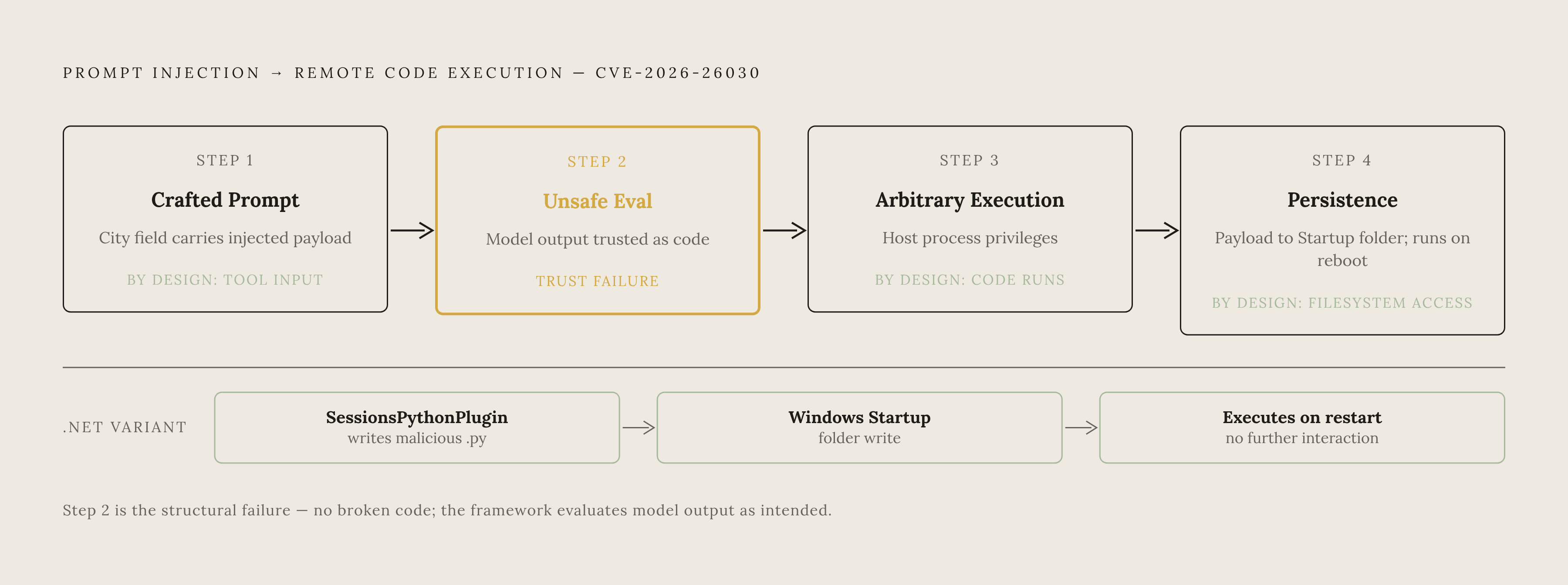
The chain from a manipulated prompt to a shell on the host machine is documented clearly enough now to walk through step by step, and it runs through code that behaves exactly as its developers intended at every stage. Each step is just the framework doing its job, which is what makes the chain so difficult to defend against with conventional input validation.
The Semantic Kernel case, tracked as CVE-2026-26030, shows the mechanism with unusual clarity. One field, meant to hold a city name, became a gateway to arbitrary code execution on the host.
A related flaw ran nearly the same route through the.NET SessionsPythonPlugin: it was an arbitrary file write, and it let an attacker drop a malicious payload into the Windows Startup folder. One prompt wrote the payload. The next system restart ran it. So full RCE came from a single conversational turn, and the attacker needed nothing more.
The CrewAI case, tracked by CERT/CC as VU#221883, shows how a quiet default configuration choice can turn a contained risk into an open one. The failure here is not a bug in the traditional sense. The sandbox is doing what its fallback logic was written to do.
The 2026 vm2 vulnerability wave extends the same pattern into JavaScript execution environments, moving at a fast pace. Each one reached the same outcome, a full escape from the sandbox to the host, through a different technical primitive: prototype pollution, exception handling abuse, async sanitization bypass, proxy unwrap, and allowlist bypasses that reached child_process directly. In an AI agent deployment, the untrusted JavaScript entering vm2 is the model's own output, shaped by a manipulated prompt. Once that output breaks out of the sandbox, the attacker inherits the privileges of the Node.js runtime itself, including process APIs, file system access, and outbound network connections.
What connects the Semantic Kernel case, the CrewAI fallback, and the vm2 wave is a shared trust relationship. Every one of these frameworks trusts parsed model output more than that output has earned, and the vulnerability sits in that trust boundary rather than in any single function.
AI-generated code as a supply of exploitable inputs
Static analysis tools were built to catch known vulnerability patterns in code written by people, patterns that accumulate in a scanner's signature database over years of human mistakes repeating themselves. AI-generated code does not reliably repeat those mistakes. It produces novel constructions and unfamiliar logic paths that fall outside what a signature-based scanner was trained to recognize, so more and more of what reaches production execution environments is code that conventional review tools were never built to catch.
This changes where the defense has to sit. By the time there's anything to scan, the manipulation has already happened upstream, inside a conversation the scanner never sees.
The vm2 disclosure wave illustrates how fast this outpaces a scan-and-patch approach at the infrastructure level. A patch surface that large, moving that quickly, does not stay ahead of a review process built around periodic scans and signature updates. Each fixed primitive left room for the next one, because the trust relationship between the library and the code it evaluated never changed.
What follows from this is not a call to abandon code review, but a recognition of its limits. One might argue that better code review, or tighter constraints on what the model is allowed to generate, reduces the flaw rate enough to make execution-level isolation a secondary concern. That argument misreads what the attack chain actually requires. The attack chain does not need flawed code generation. It only needs the model's output to influence an evaluation path, and that influence is the entire design premise of a tool-calling agent. Isolation holds regardless of whether the generated code was clean or compromised.
The CVE record on real-world sandbox escape in deployed AI systems
Sandbox escape in AI agent systems is a confirmed pattern of production exploitation; it is not a research scenario. CVE-2026-6875, affecting the ServiceNow AI Platform, carries a CVSS 4.0 score of 9.5, rated Critical, describing a network-accessible attack that requires no authentication and no user interaction, resulting in code injection and sandbox escape that leads to remote code execution. By July 20, 2026, the Canadian Centre for Cyber Security had confirmed exploitation of this vulnerability in the wild. The publicly documented entry point ran through the /assessment_thanks.do endpoint, using the sysparm_assessable_type parameter: untrusted values entered a JavaScript evaluation path that interacted with a more privileged script-loading context elsewhere in the platform. Researchers also found that commands could be executed through an instance's configured proxy or MID Server infrastructure. The exposure extended well past the single compromised instance into whatever that instance was connected to downstream.
Other cases round out the same pattern across different ecosystems. SecurityScorecard's STRIKE team found a large number of exposed OpenClaw instances across 82 countries, and a substantial subset of them were vulnerable to remote code execution, which shows how broadly AI execution infrastructure sits exposed on the open internet right now. Four separate CVEs in CrewAI, alongside a systemic class of MCP STDIO command injection flaws found across LangFlow, GPT Researcher, and LiteLLM, all trace back to the same root cause: unsafe defaults that let a prompt injection reach a shell, repeated across frameworks that teams are actively building production systems on top of today.
One recent addition reframes the threat as something that grows more capable over time rather than staying fixed. The SANDBOXESCAPEBENCH benchmark, published in March 2026, uses an Inspect-AI capture-the-flag framework to measure how well an LLM agent can exploit container vulnerabilities, including misconfigurations, privilege allocation mistakes, kernel flaws, and weaknesses in runtime or orchestration layers, with the goal of escaping nested Docker or OCI containers. It stands as the first systematic tool for measuring how capable frontier models are at attacking their own execution environment. That capability is not a fixed quantity. It tracks the capability of the models being evaluated, so the sandbox has to hold against an adversary whose skill keeps improving on its own timeline, not one whose capability was fixed at the moment the sandbox was designed.
Isolation architecture and the path from sandbox escape to host
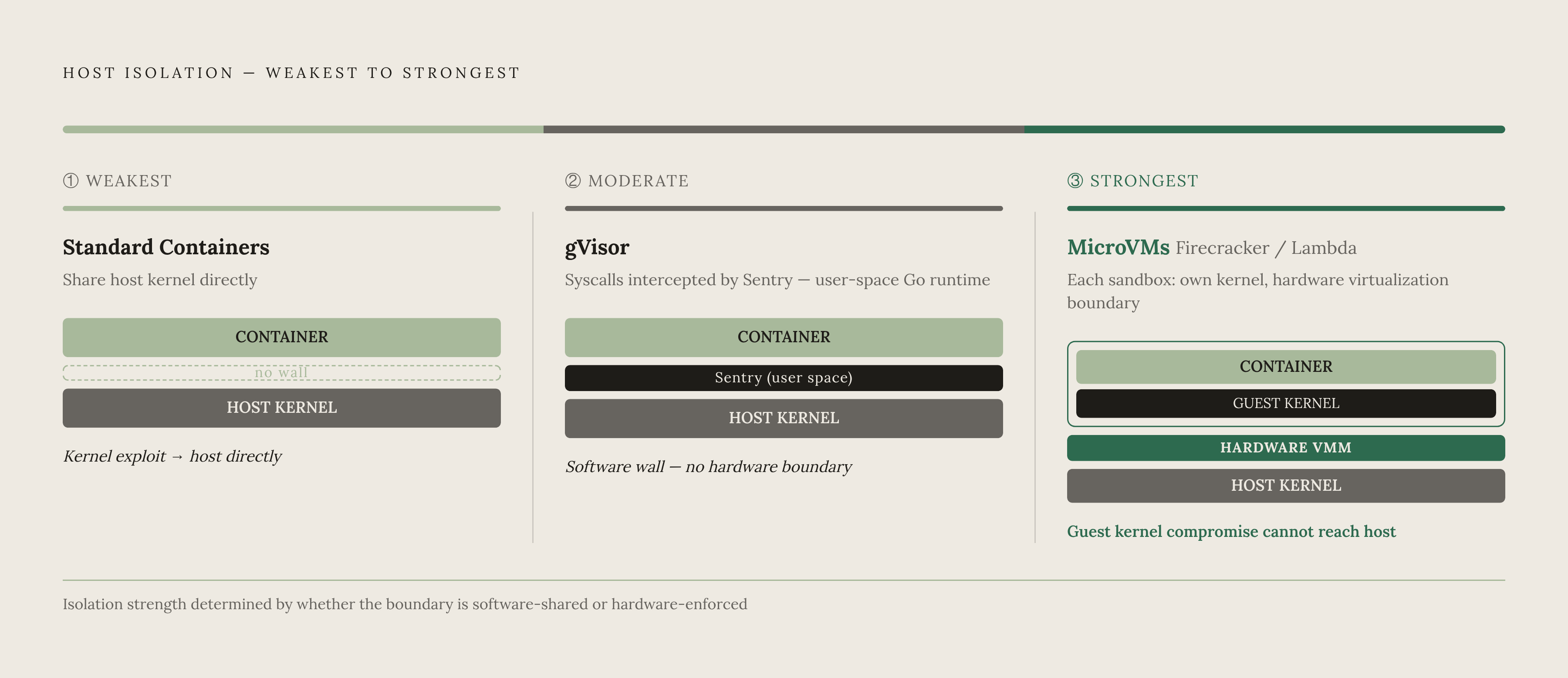
Whether a sandbox escape primitive stays contained to a single session or turns into host-level RCE depends on the isolation model chosen when the system was designed, and the gap between those models is a hardware boundary, not a setting you adjust later.
Standard containers share the host kernel with every other process on the machine. A kernel exploit, or a sufficiently privileged process escape, reaches the host directly once it clears the container's boundary, because there was never a second wall behind the first one. The vm2 wave demonstrated this path concretely in containerized Node.js deployments, where each new escape primitive led straight to the host the moment it cleared the sandbox library itself.
gVisor takes a different approach, intercepting application system calls in user space through a memory-safe Go runtime called the Sentry, so that sandboxed workloads never touch the host kernel directly. That design meaningfully reduces the attack surface compared to a standard container. But it stops short of a hardware-enforced boundary, so you still need to take seriously a sufficiently novel flaw in the Sentry's own implementation.
MicroVMs, the architecture behind Firecracker (which powers AWS Lambda), take the isolation a step further by giving each sandbox a real, if minimal, virtual machine with its own kernel. A compromise of that guest kernel does not reach the host, because the boundary between the two is enforced by the hardware's virtualization layer rather than by software running inside the same kernel as everything else. This is the architecture the available evidence points to as appropriate for code that cannot be trusted at all, which describes most of what an AI agent produces under prompt injection.
The Semantic Kernel and ServiceNow cases both illustrate why that distinction carries real weight. Only a hardware-enforced boundary breaks that pattern, because it does not matter which clever route the next escape takes if there is no shared kernel on the other side of it to reach.
That said, isolation architecture alone does not resolve every layer of the problem. A security industry analysis of the Model Context Protocol ecosystem raises a fair objection: a sandbox can be airtight and still sit beneath a protocol layer that remains unsafe above it. Their recommendation points toward protocol-level defenses, such as a restricted command grammar, a defined sandbox execution model, or a required server verification handshake, each of which reduces how much the system depends on individual developers getting sanitization right on their own. This objection does not contradict the case for hardware isolation. It adds to it. Isolation architecture is what the whole system is built on, and its failure produces a failure of everything above it. Protocol-level controls reduce how much dangerous material ever reaches that floor.
One emerging pattern treats MCP itself as a permission layer rather than merely a transport protocol. An MCP server exposes a manifest of the tools it offers, things like web_search, filesystem_read, or database_query, each scoped to a defined set of capabilities. A sandbox runtime built to understand that manifest can derive its security policy directly from it, granting only the egress and capabilities that the declared tool actually requires rather than defaulting to broad access and hoping nothing abuses it. That design direction turns the protocol layer into an ally of the isolation boundary instead of a separate concern sitting above it.
Execution architecture requirements that follow from the threat model: statefulness, egress control, and host separation
Treating the agent's own execution as the primary threat surface, rather than as a trusted extension of the developer's intent, generates a specific set of runtime requirements that a generic container or a developer's local sandbox was never built to satisfy at the same time.
Statefulness turns out to be a security requirement rather than a convenience feature. A coding agent that clones a repository, installs dependencies, edits files across multiple turns, runs a build, and iterates on the result cannot operate safely on a runtime that resets between actions. Snapshot-based resumption, the ability to capture a running environment's full state mid-execution so it can be paused, forked, or resumed later, is the mechanism that makes a long-running agent workflow both safe to operate and possible to audit after the fact.
This is where the threat model meets ordinary network architecture most directly: egress control. An AI agent deployment should be governed the way any other privileged automation identity would be, with scoped tools and bounded network egress rather than open access by default. A recent threat report from Prophaze frames this directly: allowlist the specific tools, APIs, domains, and repository sources an agent is permitted to reach, and require explicit approval for any action that changes state, communicates externally, or touches data outside its declared scope. That framing treats the agent not as a trusted user acting on someone's behalf, but as a powerful, semi-autonomous identity whose permissions need the same scrutiny given to any other credential with the ability to reach outside systems.
Host separation closes the loop that the earlier sections opened. An agent that can be manipulated through prompt injection, running on a framework that trusts its output enough to evaluate it directly, needs a boundary beneath it that holds even when every other control fails. If you pair a hardware-enforced isolation layer with persistent state for safe long-running work and a tightly scoped egress policy, you stop a sandbox escape from turning into the kind of host-level RCE that Microsoft's hotel-finder demonstration showed is already possible with nothing more than a single well-placed sentence.
Sources
- CVE-2026-6875: ServiceNow AI Platform Sandbox Escape, RCE Risk, and Safe Exposure Review
- Weekly Threat Report September 23–29, 2026: RCE & AI Access Risks
- vm2 Sandbox Escape
- When prompts become shells: RCE vulnerabilities in AI agent frameworks
- MCP by Design: RCE Across the AI Agent Ecosystem
- When Prompts Become Shells: The Agentic AI Framework RCE Epidemic of 2026
- AI Code Sandboxes: A Comparative Security Study. Part 1 of 2 -- Engine-Level Properties (Attack Surface, Leakage, Stackability, CVE History, Patch Cadence, Fuzzing)
- How to sandbox AI agents in 2026: Firecracker, gVisor, runtimes & isolation strategies