Purpose-Built AI Sandbox Providers vs Repurposed Container Tools
AI agents need stronger isolation and persistent state than containers were designed to provide.

A container isolates processes by sharing one kernel across every workload on the host, and that single shared kernel is the whole problem once an AI agent starts writing and running code nobody reviewed first. But the fence has a gap at the foundation: every container on that host still talks to the same kernel, so a single kernel vulnerability can compromise all of them at once.
That design made sense for the workload containers were built to run: application code written by a person, reviewed, compiled or deployed, and fixed in place until the next release. An AI agent breaks that assumption at the root. If that agent writes its own Python scripts, pulls in whatever packages it decides it needs, opens and closes file descriptors, and chains shell commands together without a human checking any of it, the shared kernel underneath a standard Docker container turns from an engineering convenience into a direct liability.
Docker made this case directly, which matters because Docker has the most to lose by saying it. Anyone reaching for "we already run everything in Docker" as a reason to skip this conversation has to reckon with the fact that Docker itself does not think that answer holds anymore.
The five isolation levels
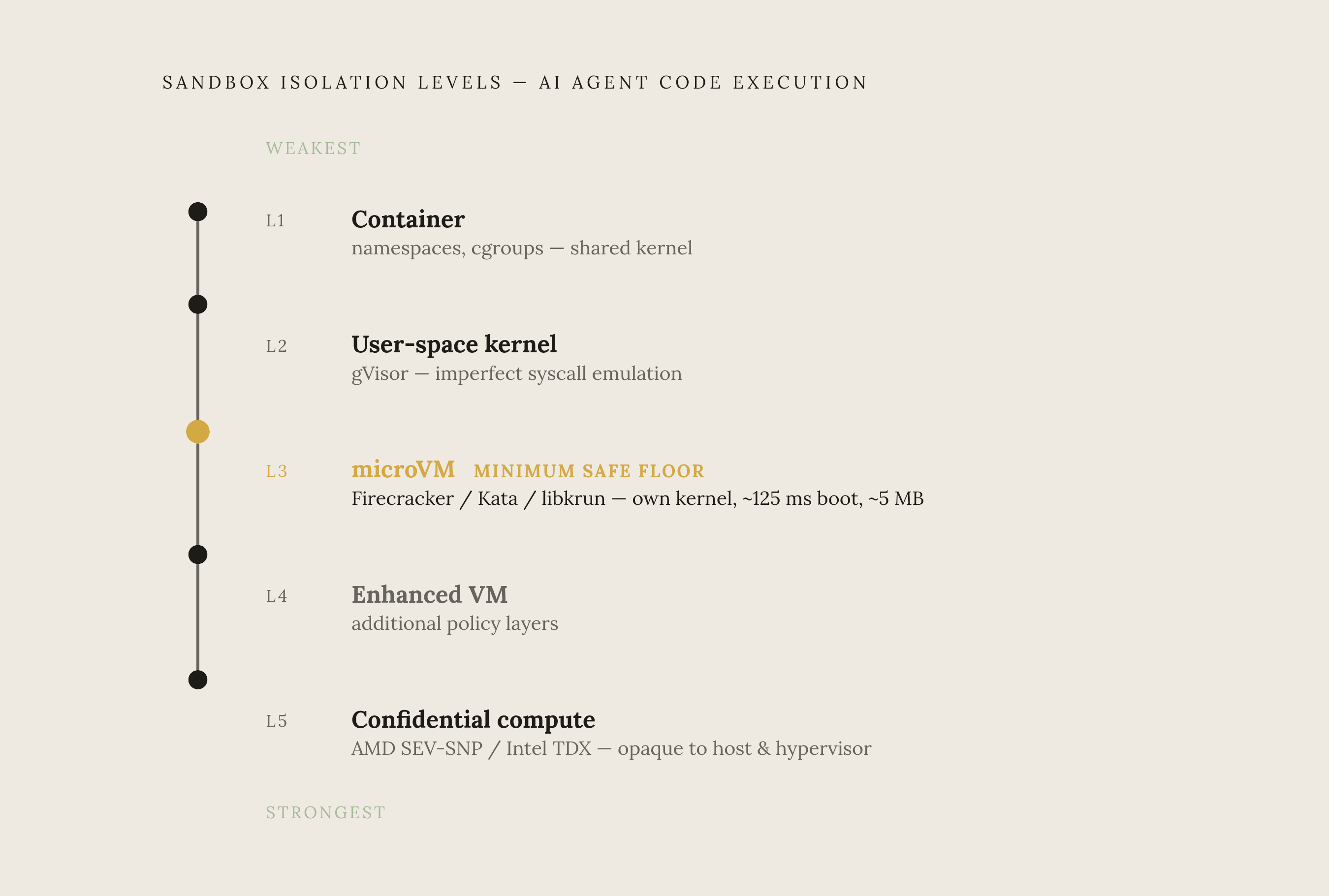
Isolation is not a switch with an on and off position. It runs along a spectrum, and each step up that spectrum buys a stronger security boundary at the cost of more overhead, so the right level for a given workload depends entirely on how dangerous the code running inside it actually is.
Level 1 is the standard container, Docker or Podman, isolating processes through namespaces and cgroups.
Level 2 moves to user-space kernels, with gVisor as the working example. The tradeoff appears in compatibility: not every syscall gets perfectly emulated, so some workloads behave unpredictably under it.
Level 3 is the microVM, with Firecracker, Kata Containers, and libkrun as the leading implementations. Each workload here runs its own kernel on top of hardware virtualization through KVM, so a kernel exploit inside one VM has no path to the host or to any neighboring VM. Firecracker boots in roughly 125 milliseconds and adds about 5MB of memory overhead, numbers that put it in range as the current standard for code a team has to treat as genuinely untrusted.
Level 5 is confidential computing, built on hardware like AMD SEV-SNP and Intel TDX, where memory itself is encrypted at the hardware level so that even the host operating system and the hypervisor managing it cannot read what's inside the sandbox.
The finding is that microVMs no longer cost what they used to. A team no longer has to trade latency for security the way it did five years ago.
That leaves the actual decision, which is a matter of matching level to threat. Trusted code, such as what an engineering team wrote itself and pushed through CI/CD, fits Level 1. Code an LLM generated to solve a math problem or reformat a file is a step up in risk, and Level 2 or Level 3 fits that. Code coming from user-uploaded binaries or from an autonomous agent installing packages nobody vetted should be treated as hostile by default. That means Level 3 at minimum. Every provider comparison that follows in this piece is really a comparison of where each option sits on this same five-level ladder, which is the frame to carry forward.
Why stateful, long-running execution breaks the ephemeral container model
Isolation is only one of the two structural problems containers have with AI agents. The second is state, or the lack of it. A standard container is built to spin up, do one job, and disappear, discarding whatever it held in memory or on disk the moment it exits. For a single, one-shot task that's fine. For a coding agent working through a real task, that overhead compounds with every step.
Picture what a coding agent actually does across one assignment: clone a repository, install its dependencies, edit files across several turns of reasoning, run a build, read the errors that build throws, and go back and fix them. On an ephemeral runtime, every one of those steps starts from zero. The agent has to re-clone the repository, reinstall every dependency, and rebuild its understanding of the codebase's current state each time it acts, because nothing persisted from the step before. That overhead does not stay constant as the task grows. It compounds at every turn, and a workflow that would take a few minutes with persistent state turns into something too slow to use in practice.
The field has started to treat this as a problem that needs formal solutions. A 2026 arXiv paper, "DeltaBox: Scaling Stateful AI Agents with Millisecond-Level Sandbox Checkpoint/Rollback," proposes checkpoint and rollback as a core primitive for scaling stateful agents, not an optional add-on bolted onto an ephemeral system. LangGraph, the agent framework from LangChain, builds its entire execution model around this same idea: compiling a graph with a checkpointer to support human-in-the-loop review, time-travel debugging, fault-tolerant execution, and conversational memory. That's a framework built by people running agents in production concluding that durable execution is a requirement, not a convenience.
The market answered in kind. Fly.io Sprites, launched in January 2026, are persistent Linux VMs with checkpoint and restore built in, designed specifically as a stateful sandbox product for AI agents rather than a general-purpose compute offering retrofitted for the job. Its existence is itself a signal: a company with deep infrastructure experience looked at the ephemeral container model and built something different because the gap was real enough to justify a new product line.
None of this means ephemeral containers are obsolete. The line runs where the task does: multi-turn coding agents, long-running autonomous work, and any process that needs to survive a disconnect or wait on a human reviewer all need a sandbox that remembers what happened in it.
How purpose-built AI sandbox providers close both gaps
Put the two problems together, isolation and statefulness, to see the shape of a real solution. A purpose-built AI sandbox provider treats microVM-level isolation and durable state as the starting design requirements, not features added after the fact to a container platform that was never meant to carry them.
A handful of characteristics mark the difference. And an API designed around the loop an agent actually runs, writing code, executing it, reading the result, writing more code, rather than an API designed around deploying a static application once and leaving it running.
Cold-start latency deserves particular attention because it shapes whether an agent feels responsive or feels broken. Purpose-built AI sandbox providers like Daytona reject the shared-kernel assumption entirely, spinning up isolated sandboxes in milliseconds with hardware-enforced isolation rather than retrofitting container primitives to a problem they were never designed to solve.
Snapshot-based dependency caching is a smaller detail that carries a lot of the practical weight here. A snapshot that bakes those dependencies in once and restores the whole environment, dependencies included, removes that cost from every invocation after the first.
Three tiers of providers have formed around these requirements. At the bottom sit the primitives: Firecracker, gVisor, and libkrun, available to teams willing to build and run their own sandbox fleet on top of them. In the middle sit Kubernetes-native projects, with Google Agent Sandbox as the clearest example, aimed at teams already running Kubernetes who want open-source sandboxing without taking on a new vendor relationship. At the top sit managed platforms, built for teams that want to hand off the operational work entirely and scale without hiring for it.
Choosing among these tiers comes down to what a team is optimizing for. Either way, the decision deserves scrutiny on vendor lock-in, which languages and runtimes are actually supported, and whether the provider allows a team to bring its own cloud account or requires running entirely on the vendor's infrastructure. That last question in particular shapes a lot of what follows in the comparison below.
Daytona
Daytona is built as secure, elastic infrastructure for running AI-generated code, with sandbox provisioning under 90 milliseconds, statefulness built into the runtime rather than added as a layer on top, and compliance treated as part of the base product.
The design starts from the agentic workload rather than from a container platform that got pressed into new service. Daytona was built from its foundation for autonomous AI systems: fast enough to provision that an agent doesn't stall waiting on it, stateful enough that an agent can leave a task mid-stream and come back to the exact same environment, and able to run indefinitely on an open-ended clock. Providers purpose-built for AI code execution, Daytona among them, sit at the intersection of Level 3 isolation, the microVM-grade separation that treats AI-generated code as hostile by default, and sub-100ms provisioning speed, a combination that ephemeral containers and user-space kernels alone struggle to deliver together.
The isolation model behind it gives each sandbox a fully separated runtime environment, closing off the specific gap a shared-kernel container leaves open: a vulnerability or a malicious action inside one sandbox cannot reach the host or any other sandbox running on it. Sandboxes persist by design and can run indefinitely, which is the direct architectural answer to the ephemeral gap described earlier in this piece: an agent can resume a long task exactly where it stopped rather than rebuilding its environment from nothing on every invocation.
Teams running Daytona can run it on their own cloud infrastructure, keeping control over where their data lives and what the compute costs, a meaningful difference from platforms that only run inside a vendor's own environment. On compliance, Daytona meets SOC 2, HIPAA, and GDPR standards as part of the base product rather than as an upgrade tier, covering the frameworks that the EU AI Act and most enterprise procurement processes now expect as a baseline. Daytona was open source under an AGPL-3.0 license before moving its production codebase to closed source in June 2026, and its last open-source release remains publicly available to fork, giving teams a way to inspect the code they're building on.
Production use already includes SambaNova, LangChain, Turing, Writer, and Clay, companies spanning LLM providers, agent builders, and enterprises running code none of their own engineers wrote by hand. The fit is clearest for teams building AI agents or products that execute code on a user's or an agent's behalf, who need to move from a working prototype to a production system without taking on infrastructure risk themselves, and who need enterprise compliance in place from the start.
Fly.io Sprites
Fly.io Sprites, launched in January 2026, are persistent Firecracker microVMs built specifically as stateful sandbox environments for AI agents, running across Fly.io's global infrastructure footprint on a storage stack and orchestration layer built new for this product.
The isolation model is Firecracker itself, giving each sandbox its own kernel through hardware virtualization, the same Level 3 guarantee described earlier in this piece. Storage runs on a 100GB durable allocation backed by object storage, with NVMe used as a read-through cache rather than as the primary store, and billing applies only to the blocks actually written rather than to the full 100GB allocation, with no charge for compute while a Sprite sits idle.
A buyer evaluating any provider's compliance claims should check what the certification covers. GDPR support works similarly, through a Data Processing Agreement that a customer needing GDPR compliance has to put in place separately.
Sprites fit best for teams already building on Fly.io's infrastructure who want to add stateful agent sandboxing without adopting a new deployment model, and for teams that need HIPAA coverage quickly through an agreement that's already drafted and ready to sign. Measured against Daytona, the practical difference sits in startup timing and deployment flexibility: a Sprite's cold boot runs one to two seconds, with warm wakes resuming in 100 to 500 milliseconds, and there's no option to run Sprites on a customer's own cloud account. Teams adopting Sprites run on Fly.io's infrastructure as a condition of using the product.
Docker Sandboxes
Docker Sandboxes launched as a cloud offering on September 24, 2026, and stand as Docker's direct answer to the isolation problem in its own flagship product, a separate line built because the company concluded that standard containers were not designed for what AI agents require of them.
Mark Cavage, Docker's president, gave the reasoning in plain terms: containers "weren't designed for the level of isolation AI agents demand." That statement carries particular weight given who made it. Docker did not need to build a separate, more isolated product line unless it believed the gap between container isolation and agent-level risk was real enough to require one, and this product is Docker's own institutional answer to that gap rather than an outside claim about Docker's limitations.
The product builds on local sandbox tooling Docker introduced earlier in 2026, extending that same approach to the cloud and offering disposable, microVM-based environments built for AI coding agents to execute in. The fit here is clearest for teams already working deeply inside the Docker ecosystem who want stronger isolation without adopting a new toolchain to get it, and for teams where Docker's existing brand and support relationships make procurement simpler than bringing in an unfamiliar vendor.