DAST vs SAST for AI-Generated Code Pipelines
AI-generated code fails security checks faster than DAST can scan deployments.
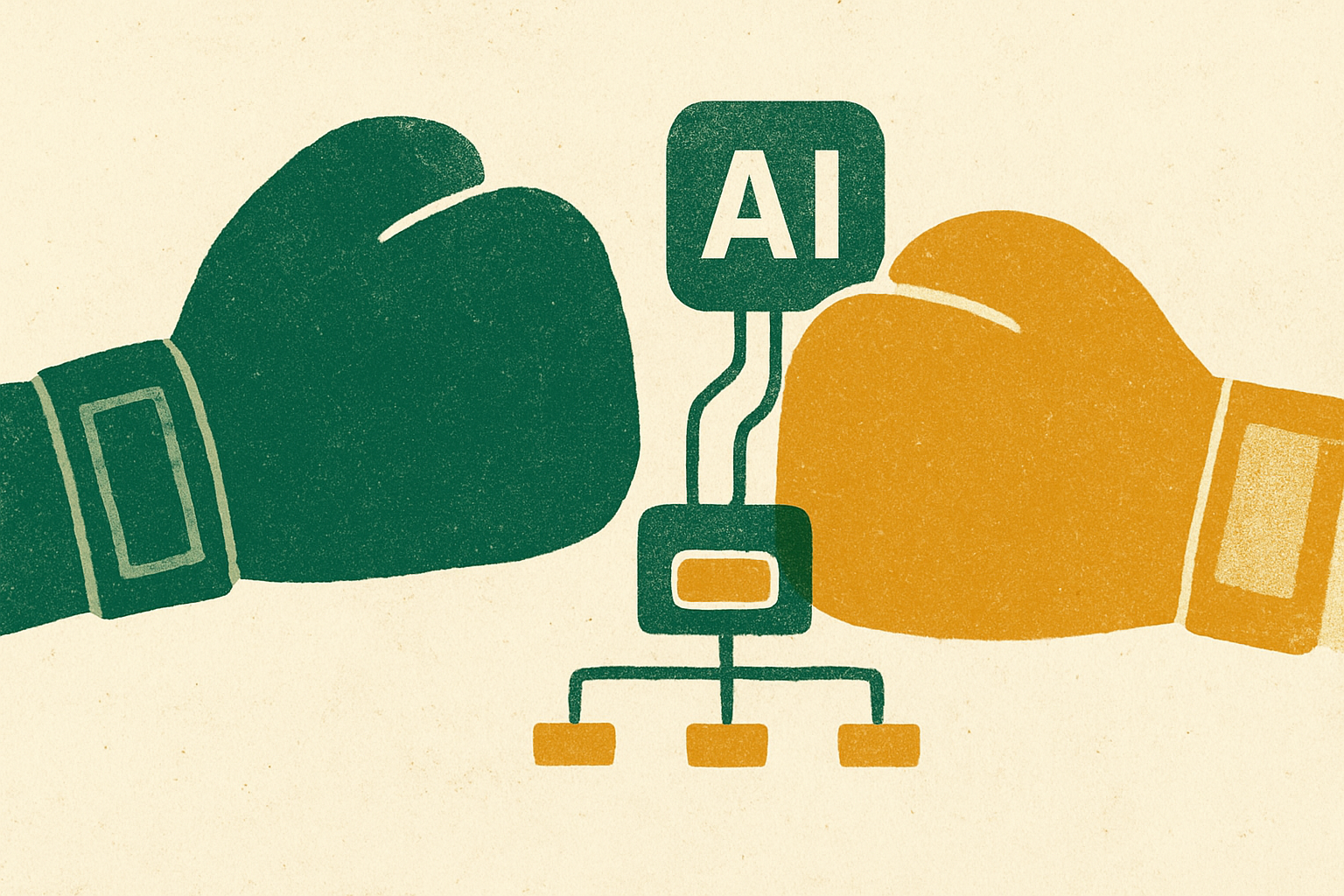
SAST checks whether code matches a known bad pattern. DAST checks whether the running app behaves the way it should. Those are two different questions, and AI has widened the gap between them, because AI now writes a growing share of what lands in your pull requests, faster than any human reviewer can keep pace with.
AI code generation stopped being a novelty a while back. At plenty of shops it's already the majority of what ships, and the vulnerability profile of that code is worse than what a person writes by hand, by a real margin. Even the best models fail close to a third of security benchmarks. The failures cluster in the same few spots: injection flaws, leaked secrets, privilege escalation paths. Veracode's 2025 GenAI Code Security Report and separate research out of Apiiro both found these show up in AI-written repos at rates well above hand-written codebases.
Developers trust the output, too, and that's the part that makes things worse. Research by Perry and colleagues found that a large share of engineers treat AI-suggested code as trustworthy without running independent tests on it. So the human review layer that used to catch these problems is thinning out right as the defect load climbs. Add in deploy cadence, teams shipping many times a day, and the monthly volume of new security findings grew roughly tenfold over six months in the repositories these researchers studied. Higher defect density, higher speed, thinner review. Put those three together and the SAST/DAST question stops being academic; it becomes the thing standing between your pipeline and a genuinely bad week.
What SAST actually does, and where it earns its place in an AI pipeline
SAST reads source code, bytecode, or a compiled binary without ever running the app. It's white-box testing, working at the level of the code itself, and that's exactly why it fits a shift-left workflow so well. It lives in the IDE, runs on every commit in CI, and catches problems the moment they're written instead of waiting for something to break in front of a user later.
What makes SAST useful for AI pipelines is how closely its strengths line up with what these models get wrong. SQL injection, cross-site scripting, hard-coded credentials, insecure API calls, buffer overflows, misconfigurations: these are pattern-matchable flaws, and they happen to be exactly the categories where AI-generated code fails most often. That overlap isn't quite a coincidence. It's the reason SAST gets a front-row seat in any pipeline handling machine-written code.
The tools have gotten sharper about cutting noise, too. AI-augmented SAST now pairs deterministic pattern matching with LLM-driven semantic reasoning and reachability analysis, checking whether a flagged pattern is actually reachable from user input instead of flagging every surface match regardless of context. SonarQube and Semgrep give solid defaults for teams that want something running fast with no fuss. CodeQL goes deeper on semantic analysis for teams that need it, and Snyk Code gives feedback right in the editor. Checkmarx, named a leader in Forrester's 2025 SAST Wave, has built out support for inner, middle, and outer-loop agentic workflows, which matters when your "developer" is increasingly an autonomous agent instead of a person typing in an IDE. At this volume of generated code, catching a large class of syntactic bugs early beats letting them pile up until DAST catches them, or until a user does.
The false positive problem SAST creates at AI-code volumes
Untuned, SAST tools throw off a lot of false positives. The exact rate swings widely across industry benchmarks, from a majority of findings on the bad end down to something manageable once the tool is properly tuned to the codebase it's scanning. That range matters, because at AI-code volumes, even a moderate false positive rate stops being an annoyance and starts doing real damage.
Alert fatigue sets in fast. Engineers start scrolling past findings instead of reading them, and once that happens, the real vulnerabilities buried in the noise lose their signal along with the junk around them. Pipelines slow down too, which defeats the whole point. Teams adopted AI-assisted development to move faster, not to add a bottleneck at the scanning stage.
There's a deeper limit that no amount of tuning fixes, though. SAST matches patterns, and a missing authorization check doesn't have a pattern. There's no signature for "this endpoint should have required an admin role and didn't," because whether that check belongs there depends entirely on your application's own logic. AI models make this worse, since they optimize for code that looks plausible rather than code that reflects the actual intent behind a feature. Business logic errors show up at elevated rates in AI output specifically, and SAST can't tell a deliberate design choice from a mistake. It was never built to make that call.
Secrets exposure sits in a similar blind spot. AI-generated repos leak secrets (API keys, tokens, and credentials) at higher rates than traditional projects, and most organizations still don't run secret scanning tuned specifically for AI-generated code. This category often needs semantic context rather than a pattern match, which is exactly where static analysis runs out of road. SAST handles the syntactic layer well once tuned, but something else has to cover what has no static signature at all.
What DAST covers that SAST structurally cannot
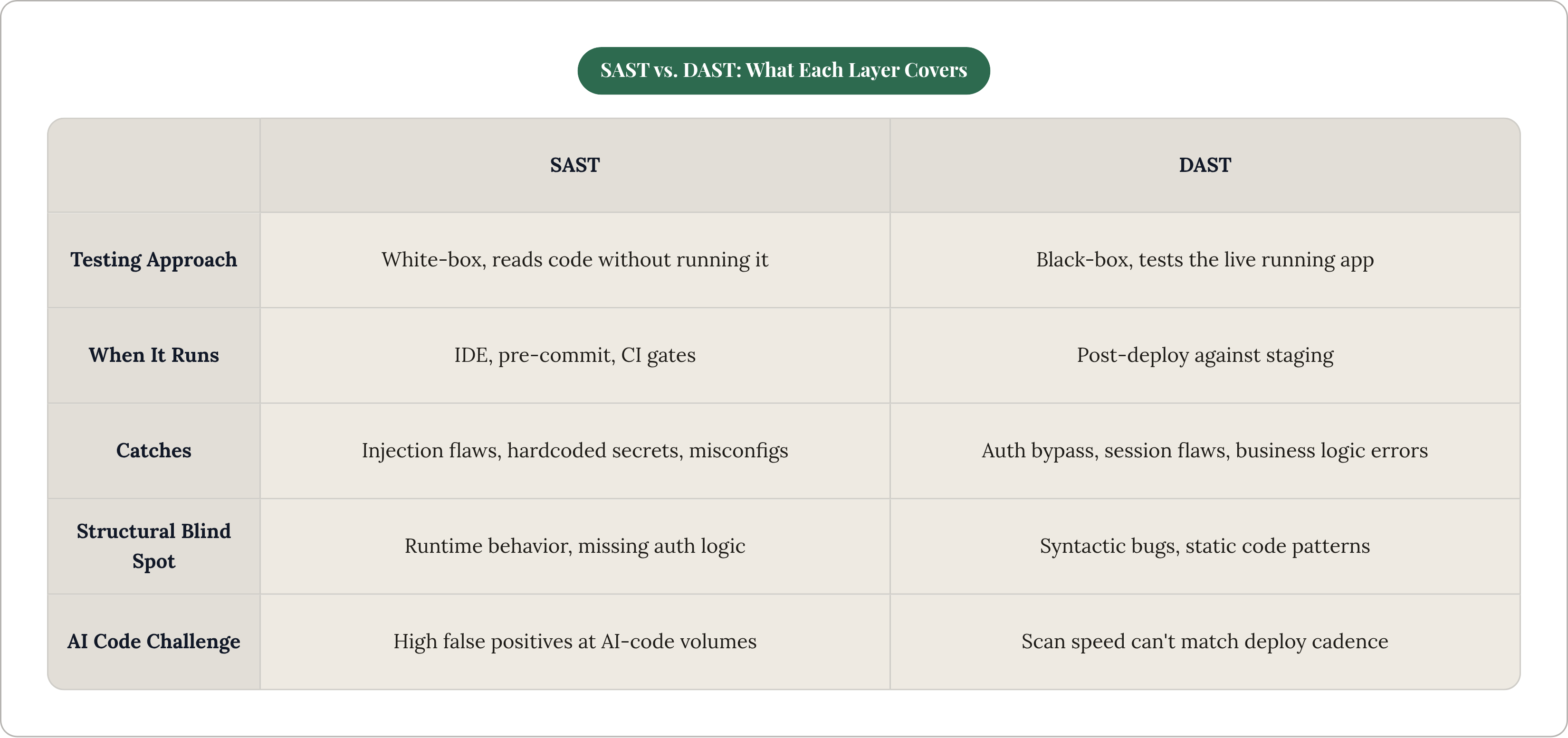
DAST works from outside the running app. It sends payloads, watches how the system responds, and checks behavior as the application actually executes, with no need to see the source code at all. Call it black-box testing if you want the textbook term; that outside vantage point is what lets it see things SAST cannot.
Authentication bypass, session management flaws, reflected XSS that only shows up in a live context, server-side request forgery, business logic failures, configuration issues that only surface once the app is running somewhere close to its real environment. None of these carry a static signature. They come out of the interaction between code, configuration, and runtime state, which is exactly why a tool that never executes the code can't find them. Given how often AI-generated code produces business logic errors in the first place, this layer matters more as generation volume climbs, not less.
For AI pipelines, DAST should run against staging or a pre-production environment after deploy, with authentication configured so the scanner can actually reach the protected parts of the app instead of bouncing off a login page. Good practice at this point means automating the scan on every deployment, using delta scanning to limit scope to whatever surface actually changed, and tuning the scanner to the application's own logic so findings stay actionable instead of theoretical.
SAST and DAST inspect different layers of the same system, and the vulnerabilities each one catches are mostly separate sets. Skip one and you leave an entire category of risk uncovered. Which category depends on which tool you skipped.
The speed mismatch that defines the DAST challenge in AI pipelines
A full DAST scan can take many hours to run. AI-assisted teams often deploy many times a day. Do that math and most deployments simply go unscanned between the weekly or biweekly DAST cycles a lot of teams still run. That gap isn't hypothetical, either: known vulnerabilities can start getting exploited within days of exposure, well inside the window a scheduled scan leaves open.
So what do you actually do about it? The fix involves rethinking how DAST gets deployed, not dropping it. Delta scanning helps: scan only the surface that changed in the latest deployment instead of re-scanning the whole app every single time. Triggering scans off deployment events instead of a calendar closes another piece of the gap. Tiering coverage by risk helps too, saving the full scan for changes that touch sensitive areas and using lighter, focused scans for the routine deployments that don't.
As SAST moves deeper into the IDE and absorbs more of the syntactic layer automatically, DAST's job as the runtime validation layer gets more concentrated, and more critical along with it. Its coverage gap relative to deployment speed keeps widening rather than narrowing. Closing that gap through smarter deployment strategy is a real priority now, not something to circle back to once things calm down.
Where IAST and RASP extend coverage that neither SAST nor DAST reaches
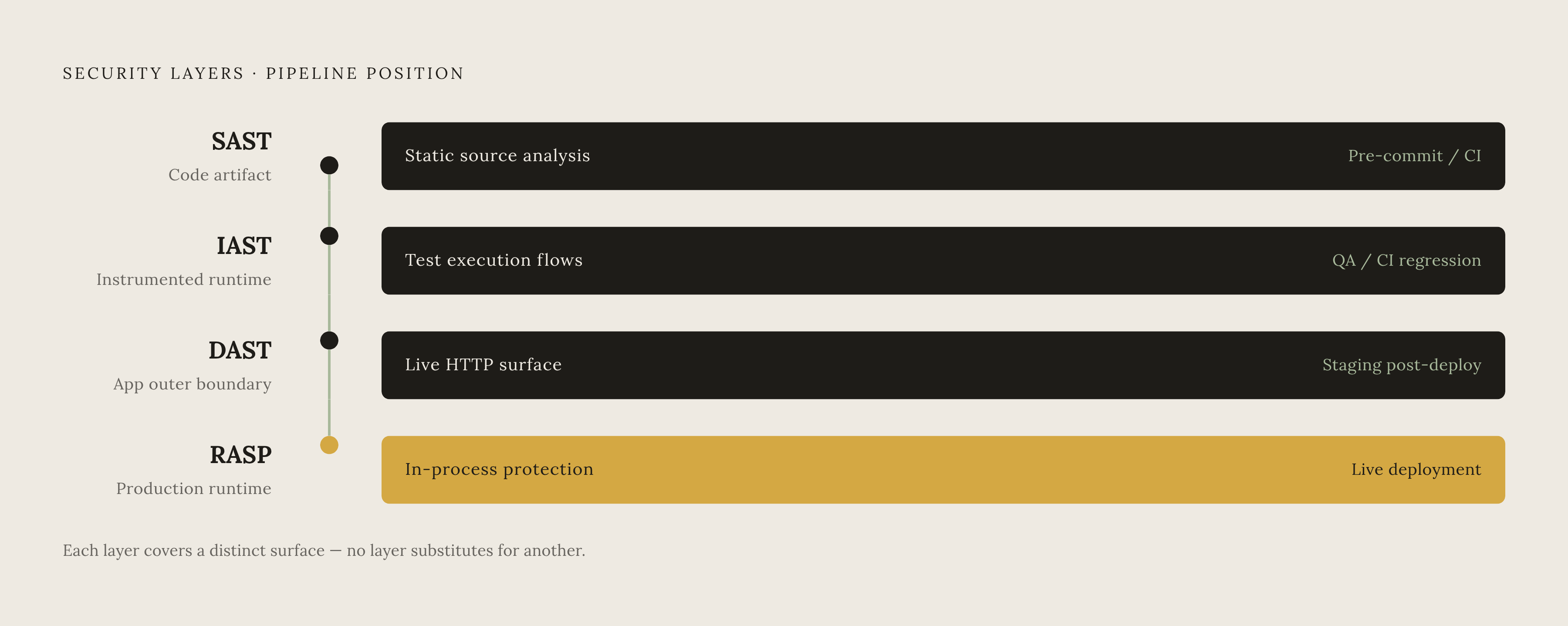
IAST sits inside the running app during QA and regression testing. It combines the code-level visibility SAST has with the runtime context DAST has, which is why it tends to throw fewer false positives than static analysis running alone. Gartner's 2024 report on the category notes substantial growth in IAST adoption, driven largely by that noise reduction. The practical way to fold it in: run IAST whenever your automated regression suite already runs, since it adds signal in the same CI pass without bolting on a whole new scanning phase.
RASP works differently. It's not a testing tool at all, but a shield embedded inside the deployed app itself, watching inputs and data flows in real time and blocking or killing malicious requests as they happen. Contrast Protect is one example, and it runs with a performance cost low enough that most production workloads never notice it's there. RASP matters specifically for AI-generated code because it is the last line of defense when code passes every pre-deployment gate cleanly and still carries a logic flaw that only surfaces under adversarial input nobody tested for.
Each tool covers a distinct surface: SAST at the code artifact, DAST at the app's outer boundary, IAST during instrumented test runs, and RASP at the production runtime itself. None substitutes for another. A pipeline leaning on just one or two of these is leaving specific, known gaps open, on purpose or not.
How to sequence these tools into a pipeline built for AI-generated code
Order matters here as much as coverage does, across four stages moving through the development cycle.
Secrets detection and SAST belong at the pre-commit stage, either in the IDE directly or through pre-commit hooks. This is the highest signal-to-noise ratio you'll find anywhere in the pipeline, at the lowest cost, and it catches the most common AI-generated vulnerability classes before the code is even pushed.
CI gates on the pull request come next: tuned SAST, software composition analysis for dependency vulnerabilities, and infrastructure-as-code scanning. These run automatically, staying out of the way for changes that come back clean and blocking only when something high-severity turns up. CD gates fire before anything hits the registry: container image scanning, one final pass over the artifact. Post-deployment, DAST runs against staging, automated and delta-scoped, alongside IAST during regression runs and RASP watching production live.
For a team building this from scratch: start with secrets detection, since it's the highest-impact, lowest-false-positive layer you can add, then move to SCA, then tuned SAST, then IaC scanning, then DAST. Each layer earns its place before you stack the next one on top of it.
One adjustment specific to AI pipelines: pre-commit and CI carry more weight than they do in a traditional pipeline, simply because the volume hitting those gates runs an order of magnitude higher, and the defect density is higher too. Investment at those early stages pays back disproportionately. For DAST configuration specifically: authenticate fully into the app, scope scans to changed surfaces only, trigger off deployment events instead of a schedule, and tune to the app's actual logic before treating any finding as worth acting on.
Why running AI-generated code safely requires more than a security scanner
SAST and DAST detect and validate. That's the job, and they do it well within their own layers. Neither one has anything to say about what happens once vulnerable or untrusted AI-generated code actually starts running, though, and that's a separate problem entirely.
The threat model here is genuinely different from human-written code. Nobody reviewed every line the way a senior engineer reviews a colleague's pull request, and a lot of it can't be fully reviewed before it runs at all. It might attempt something destructive, resource-hungry, or insecure, even after clearing every static and dynamic gate you built for it. Standard containers don't answer the question of what happens when something slips through everything you've set up, because containers share a host kernel. An exploit inside one can reach the host or a neighboring workload.
I sat on an incident call once that started as a "contained" break-out and turned into four hours of nobody sleeping because of exactly this gap. Not fun. Not a story I like retelling, honestly, but it's the reason I don't trust a container boundary the way I used to.
MicroVM-based isolation takes a different approach. Each workload gets its own guest kernel, enforced by hardware virtualization, so an exploit gets contained at the hypervisor boundary instead of the container boundary. Across the three main isolation architectures in use today (microVMs, gVisor, hardened containers), microVMs offer the strongest guarantee for code you genuinely can't trust yet. Fully untrusted execution is exactly the situation AI-generated code puts you in, whether or not it passed your scanners.
Why do purpose-built sandboxes for AI agents even need to exist? Because general-purpose containers and developer sandbox tools were never built for this job. Agents need sub-second provisioning to stay responsive at scale and stateful execution so long-running tasks don't lose context between steps. They also need network and permission controls tight enough to limit the blast radius if something does go wrong.
Daytona is one option built around this threat model. It offers isolated runtime boundaries, provisioning fast enough that agents don't stall waiting on infrastructure, stateful execution that can run indefinitely, and Docker-native compatibility so teams don't have to rewrite their stack to use it. It also carries SOC 2, HIPAA, and GDPR compliance for organizations that need to run AI workloads in production without taking on new infrastructure risk. The architecture is open-source and transparent by design, a deliberate contrast to black-box execution services. When the code your runtime executes is itself opaque, you want the runtime around it to be the opposite.
SAST catches syntactic vulnerabilities the moment code gets written. DAST checks behavior at the app's boundary once it's running, and IAST and RASP fill in the gaps between and beneath those two. A purpose-built runtime isolates execution underneath all of it, so whatever slips past both scanners still can't reach the infrastructure sitting beneath it. Four layers, none of them sufficient alone, each covering ground the others structurally cannot.