Docker Image Scanning Tools Compared for AI Pipelines
Trivy's supply-chain attack exposes why scanner provenance matters more than features for AI teams.

Docker image scanning tools all claim to do the same job: pull an image apart, check its packages against known vulnerabilities, hand back a report. Those differences only show up once you put these tools in front of an AI pipeline, where Dockerfiles get written by coding assistants, images rebuild dozens of times a day, and dependency trees pull in packages nobody on the team has read the release notes for. The differences that follow are sometimes unpopular with whoever's still buying scanner licenses by feature checklist alone.
Start with what's actually different. An AI coding assistant writing a Dockerfile has no concept of CVE exposure; it's pattern-matching against training data, not checking upstream security advisories the way an engineer might before pinning a base image. Model serving images add another layer of exposure just by existing: a CUDA runtime, a stack of framework wheels, a handful of data-processing libraries, each one dragging its own vulnerability surface into the build. Then there's churn. A traditional pipeline might rebuild a handful of images a week; an AI pipeline rebuilds on every model iteration, every prompt tweak, sometimes every commit, and that volume outpaces what manual review or a slow scanner can keep up with. Add in base images pulled from registries nobody vetted because the fine-tuning environment needed one specific PyTorch build, and you've got a pipeline producing images faster, and with less scrutiny, than anything that came before it.
The baseline risk isn't small to start with. Snyk's own data puts the share of public container images carrying at least one high-severity CVE at 87%, and 44% of Docker Hub images carry something critical. Those numbers land harder on AI teams specifically, because so much of the ML tooling ecosystem lives on community-published base images rather than vendor-hardened ones. Against that backdrop, things that would be minor annoyances in a slow, human-reviewed pipeline (false-positive rate, scan speed, whether the tool keeps state between runs, whether it works offline) turn into the difference between a pipeline that catches real problems and one that stalls or gets ignored, quietly, until someone notices six weeks later that nobody's been reading the alerts.
A supply-chain incident that reframes how you think about scanner trustworthiness
In March 2026, Trivy became the story it usually reports on. Attackers hijacked GitHub Actions tags tied to the project, pushed fake releases, and got malicious images onto Docker Hub under Trivy's name. Vulnerability database updates were suspended while the incident got sorted out. The tool built to catch supply-chain risk had become one.
This isn't a story about one project having a bad month. Build system attacks and compromised registry pulls have picked up noticeably since early 2025, and a scanner occupies a strange spot in that landscape: it's software you trust to tell you what to distrust. A scanner pulling its database or binary from an unverified source is itself a dependency, deserving the same scrutiny you'd apply to a base image. How many scanning tools in your pipeline auto-update without a human ever looking at what changed? That's exactly the exposure AI pipelines carry more of, since a lot of the appeal of automating a pipeline is removing the human checkpoint that would have caught something like this.
So what should you check before handing a scanner a job this central? Signed releases you can verify against a known key, matter. Clear documentation of where the vulnerability database comes from and how it updates, matters more than most vendors let on. The ability to run fully offline without phoning home closes off an entire attack surface by itself. And some evidence the vendor has handled an incident like this before, and said so publicly instead of burying it in a changelog nobody reads, tells you more than a feature comparison ever will. None of this replaces evaluating what a scanner actually catches; it just means capability without that kind of provenance isn't worth much, and the comparison below should be read with that in mind.
What each major scanner actually does, and where its design assumptions break in AI pipeline conditions
Trivy, from Aqua Security, is a single binary that scans images, Infrastructure-as-Code files, Kubernetes manifests, secrets, and SBOMs. It's MIT licensed, with its own vulnerability database updated frequently. That breadth genuinely helps AI pipelines, which produce more than just images: an AI assistant might generate a Terraform file alongside a Dockerfile, and Trivy covers both. But each scan is stateless. There's no central server tracking findings over time, no ticket integration, nothing turning a hundred scans a week into a coherent picture of what's actually getting better. Trivy's aggressive inclusion also means it flags packages that distros like Red Hat and Debian have already patched via backport, without bumping the version string the scanner checks against; the result, at AI pipeline volume, is noise that trains engineers to stop reading alerts. After March 2026, Trivy also carries the added weight of needing its own binary and database provenance checked before a team goes back to trusting it on autopilot.
Grype, from Anchore, does one thing: vulnerability scanning, paired naturally with Syft for SBOM generation. It matches package versions more precisely than Trivy does, which cuts the backport false-positive problem substantially. In one internal test comparing scans across a set of enterprise images, Trivy returned roughly a fifth more findings than Grype, and after triage, most of that extra volume turned out to be exactly the backport noise described above. Grype tends to run faster too, since it isn't trying to cover IaC and secrets and manifests in the same pass, and that matters when CI kicks off a new scan on every model iteration. It layers in EPSS scores and CISA's Known Exploited Vulnerabilities catalog, helping teams tell the difference between a CVE that's theoretically severe and one actually being exploited in the wild, which is exactly the kind of prioritization an alert-fatigued team needs. The tradeoff is scope: teams needing IaC or secrets scanning have to bring in something else alongside it.
Snyk Container runs on a proprietary vulnerability database that tends to surface CVEs earlier than public feeds, and its Reachability Analysis checks whether a vulnerable code path actually gets called, not just whether it's present somewhere in the image. That's a different kind of false-positive reduction than Grype's version-matching, and it goes deeper: it looks at application dependencies inside the image, not just OS packages, which matters a lot for Python-heavy ML images with sprawling transitive dependency trees. Snyk also generates fix PRs and suggests alternate base images automatically, cutting the review burden when a model wrote the Dockerfile instead of a person. The catch is that full functionality is cloud-hosted; getting the complete feature set means sending image data to Snyk's servers, which rules it out for air-gapped inference environments or regulated healthcare and finance deployments where that's not negotiable. The CLI exists but doesn't fully substitute. Pricing starts at $45 per developer per month, worth factoring in for teams where "developer" now effectively includes a growing number of automated pipeline actors.
Docker Scout is the low-friction option for teams already living inside Docker's tooling. It handles SBOM analysis and gives remediation hints with basically no learning curve. It fits an individual developer checking an AI-generated image before pushing it somewhere shared, but it wasn't built for policy enforcement or high-volume automated scanning across a pipeline, and its depth grows on Docker's own roadmap rather than as an independent product.
Anchore Enterprise adds policy-based scanning on top of the open-source Grype engine: define which CVE classes actually matter to your organization, and enforce that as a gate in CI rather than just a report. That's valuable when AI-generated images need to clear a defined compliance bar before reaching production. It's built for organizations where governance carries as much weight as detection, which is a smaller set of teams than you'd think, but a real one.
OX Security was built specifically for the problem this piece keeps circling back to: AI-generated code. It validates AI-generated Dockerfiles, dependencies, and configurations at build time, then tracks those artifacts from the registry through to runtime, and it can block a build automatically when it catches an insecure pattern an AI assistant introduced. Of everything covered here, it's aimed most directly at the authorship problem rather than a generic vulnerability problem.
Wiz and Prisma Cloud, at the CNAPP tier, go past image scanning entirely. They correlate a vulnerability with runtime context: is this container actually running, and is the vulnerable package even reachable over the network from where it sits? Wiz's Security Graph maps attack paths rather than just listing CVEs, which matters for AI inference infrastructure where a compromised container might have privileged access to model weights or customer data. These tools earn their keep once an organization needs visibility across its full cloud footprint, not just its registry.
How to match scanner characteristics to the specific pressures your AI pipeline creates
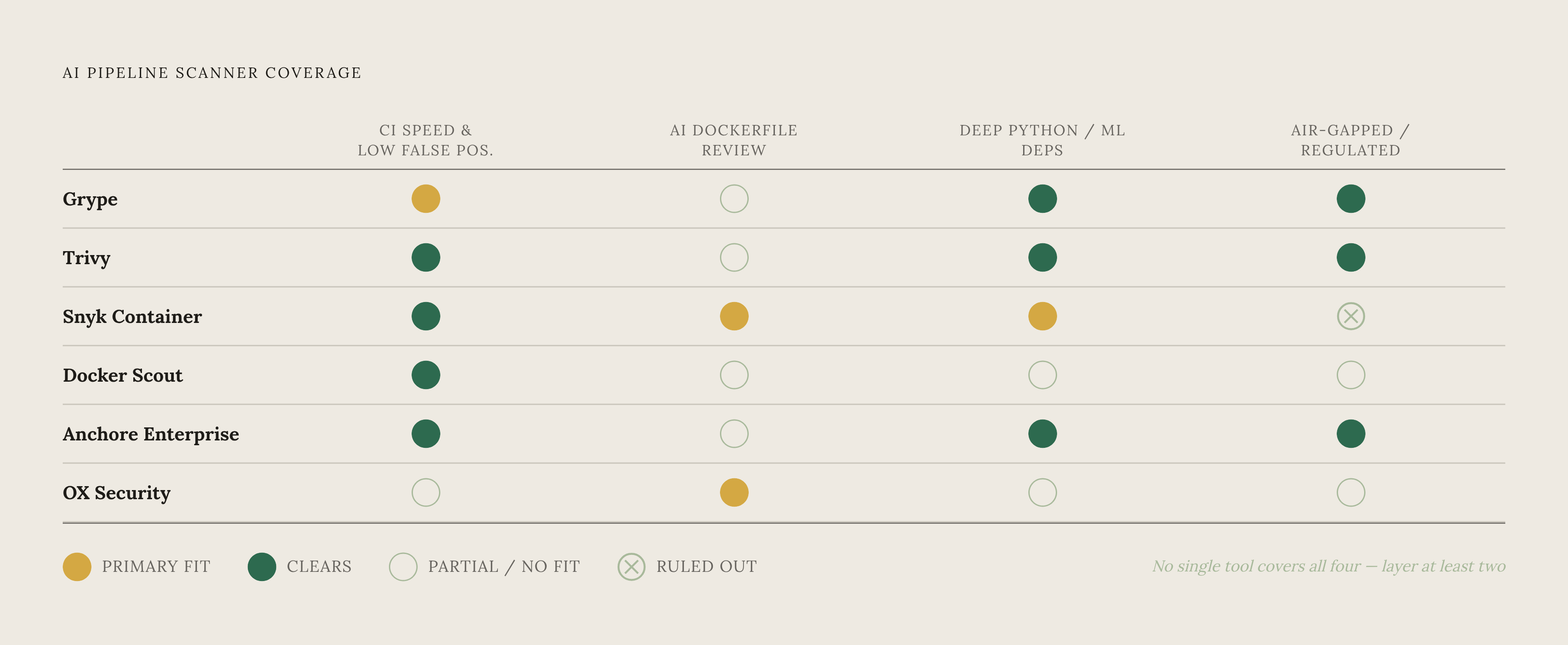
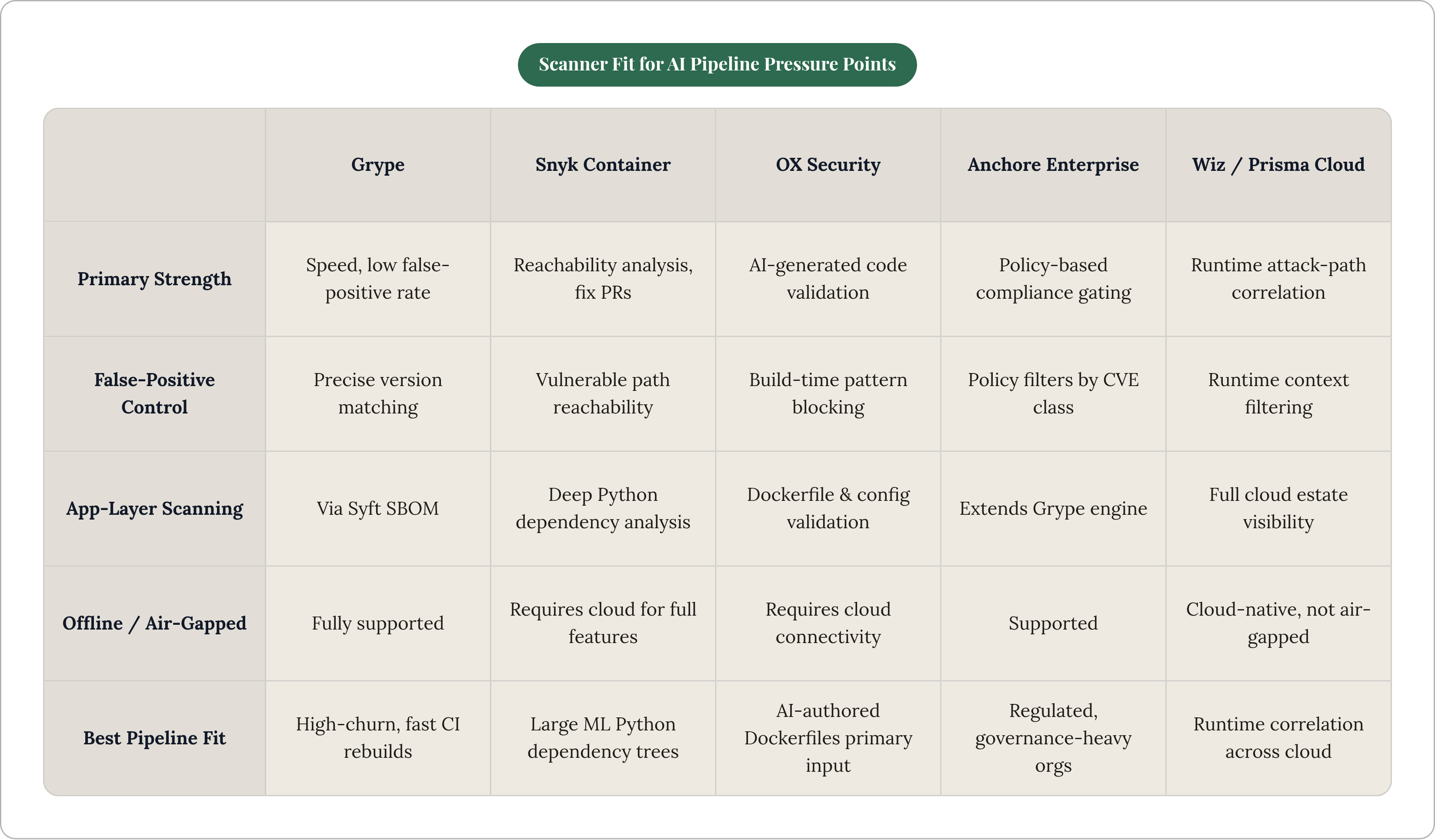
Pick a scanner by diagnosing your pipeline's actual pressure point first, not by whichever tool your security team already had a license for. Most teams only really feel one or two of these acutely, and the honest move is figuring out which one before you buy anything.
If your CI rebuilds on every model iteration, speed and false-positive rate matter more than breadth of coverage. A slow or noisy scanner in a high-churn pipeline either becomes the bottleneck everyone complains about in standup, or gets quietly bypassed, which is worse. Grype's speed and lower noise on distro-patched packages suit this pattern well.
If engineers are reviewing Dockerfiles an AI assistant wrote rather than authoring them from scratch, the scanner's job shifts toward cutting review burden. Snyk's automated fix PRs and OX's build-time validation both aim at that specific problem: less time spent figuring out what to do about a finding, more time spent deciding whether the fix is right.
Images with deep Python dependency trees, which describes nearly any ML serving image, need scanning that goes past OS packages into the application layer. Snyk's reachability analysis addresses this directly; Grype paired with Syft gets you there too, anchored to an SBOM rather than a proprietary database.
Operating in a regulated or air-gapped environment rules out anything requiring cloud connectivity for full functionality, which knocks Snyk's complete feature set out of contention. Trivy and Grype both run fully offline, though the March 2026 incident means offline capability is only as trustworthy as your own verification of where the database actually came from.
No single tool covers every one of these surfaces at once, so most teams end up layering: Grype for the fast vulnerability pass, a separate scanner for IaC and secrets in AI-generated manifests, a CNAPP layer for runtime correlation once things are deployed. Worth being honest, too, about whether your pipeline has a human in the loop at all. If AI agents are deploying images autonomously, an advisory-only tool like Docker Scout isn't enough, because nobody's reading the advice. That's a job for a scanner with a real policy gate, something like Anchore Enterprise's rule engine or OX's automated blocking, that hard-stops a build instead of just flagging it and moving on.
Underneath all of this sits one unglamorous requirement: generate an SBOM at build time, every time, and store it with the image. For AI-generated images where the dependency graph is opaque by nature, that SBOM is what makes any later scan actually mean something. Grype with Syft, and Docker Scout, both make this easy to set up as a default instead of an afterthought.
Where the scanner ends and the execution environment begins
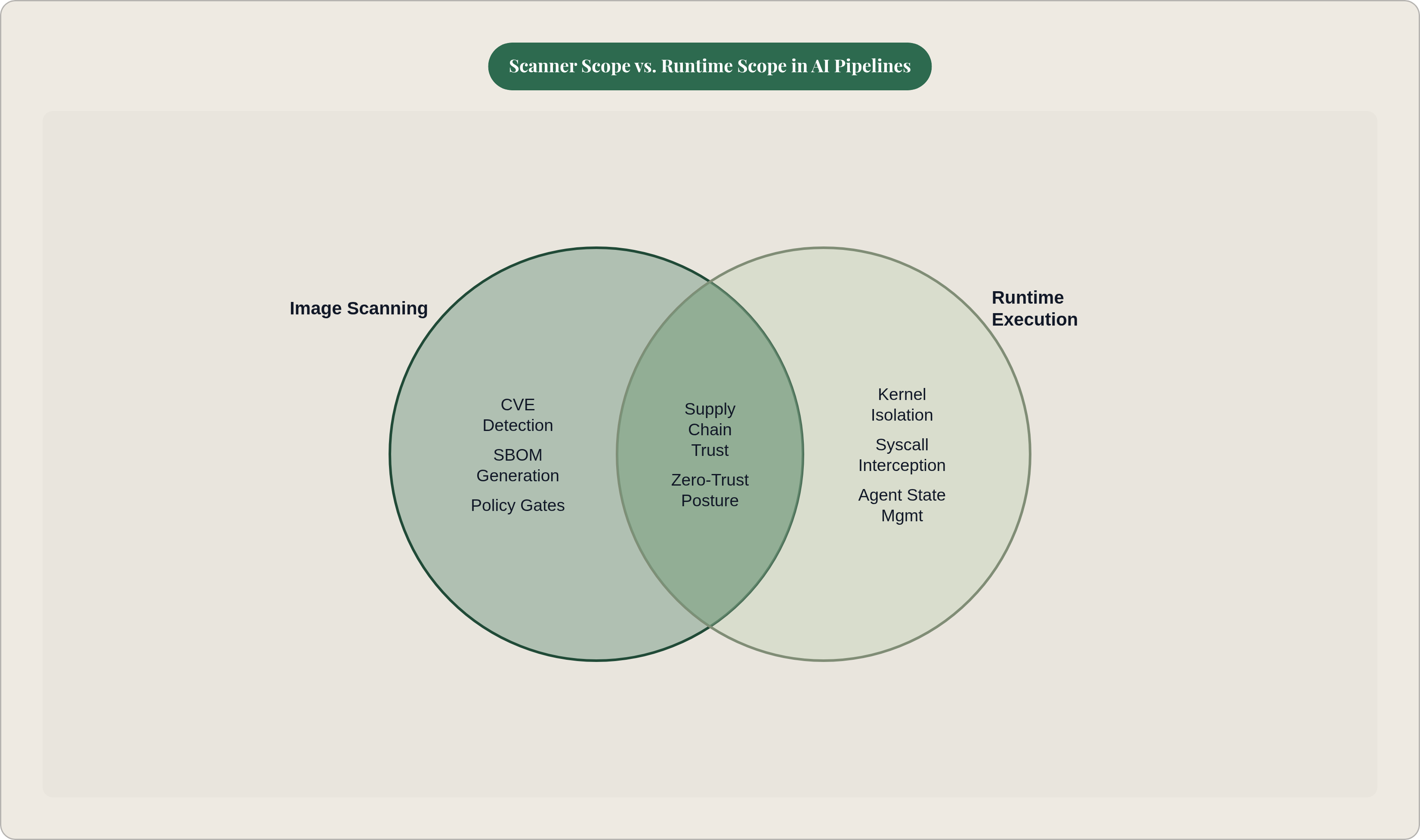
A clean scan tells you about the image, not about what happens after the image starts running. That's not a knock on any scanner covered above; it's architecturally outside the job description. An AI agent that writes and executes code at runtime, a Python script generated on the fly, a shell command built from a model's output, produces code that was never in the image and so was never scanned. No amount of scanning the base layer catches that, because the risk doesn't exist yet at scan time.
This is a demonstrated category of failure, not a hypothetical one. CVE-2024-21626, the "Leaky Vessels" vulnerability in runc, let a process escape its container through a flaw in the container runtime itself, on an image that could have passed every scan cleanly. Container isolation shares the host kernel; that's not the same guarantee as kernel-level isolation, and the distinction matters enormously once you're running code an AI agent generated moments ago rather than code a person wrote and reviewed days ago.
A few things follow from that for infrastructure choices, and they're worth stating plainly rather than hedging around. Standard containers aren't the right isolation boundary for AI-generated code; something stronger, a microVM or syscall-level interception, is the more appropriate baseline. The execution environment needs to default to distrust, a zero-trust posture where an agent's actions are explicitly permitted rather than implicitly allowed just because the container started successfully. And agents doing long-running work need somewhere to keep state across steps: an ephemeral container that loses everything on restart pushes teams toward cramming an entire agent's workflow into one oversized session just to avoid losing progress, which is its own kind of risk, and not a small one.
Daytona sits at this layer, downstream of the scan rather than replacing it. It offers sandbox provisioning in under 90 milliseconds, kernel-level isolation, stateful execution so long-running agents don't lose their place, Docker-native compatibility so teams aren't rewriting existing image workflows, and SOC 2, HIPAA, and GDPR compliance for teams that need that on the record. It's open-source too, which matters specifically here: a runtime an AI agent's code runs inside isn't somewhere you want to take a vendor's word for it. Scanning decides what's allowed into the environment. The runtime decides what's allowed to happen once it's there. Treat those as the same question, and the more dangerous half of the problem goes unaddressed.
A practical starting configuration for teams building AI pipelines today
If you're setting this up from scratch, a reasonable baseline looks like this: Grype, paired with Syft, as the primary scanner and SBOM generator, because it's fast, quieter on ML base images than the alternatives, prioritizes with EPSS and KEV data, and runs fully offline. Add a dedicated IaC scanner, Checkov or something comparable, for the Dockerfiles and Kubernetes manifests an AI assistant is generating, since Grype doesn't touch that surface. Put a policy gate in CI that hard-blocks on critical CVEs matching the CISA KEV list, because advisory output alone doesn't work when there's no guaranteed human reading it. And generate an SBOM at every build, stored with the image, so that six months from now an audit or a new CVE disclosure doesn't mean re-scanning everything from scratch just to figure out what's exposed.
From there, add tools as the pain shows up, not before. Reach for Snyk when the team needs reachability analysis across a large Python dependency tree and the automated fix PRs are worth the cloud-connectivity tradeoff. Reach for OX Security when AI-generated Dockerfiles are a primary input and build-time validation of what the model wrote is a real priority, not a nice-to-have. Reach for Wiz or Prisma Cloud once runtime correlation and visibility across the whole cloud estate matter more than image scanning on its own.
Whatever you pick, treat the scanner itself as a dependency: verify binary and database provenance, pin versions instead of floating on latest, and don't let it auto-update without someone actually looking. That's not paranoia; it's the direct lesson of what happened to Trivy in March 2026. Pair whatever scanning stack you land on with an execution environment built for AI-generated code, because scanning governs what gets in, and the runtime governs what it's allowed to do once it's there. The goal was never the most exhaustive scanner. It's the fastest feedback loop that still catches what's real, without generating so much noise that nobody reads it anymore.