Kubernetes Container Scanning Tools for AI Pipeline Images
AI pipeline images need layered scanning beyond standard container tools.
A container image built for a PyTorch training job carries a different risk profile than a web app image, and the standard scanning playbook wasn't written with that difference in mind. This piece walks through the tools built to close that gap: Trivy and Grype as the baseline pair, admission control and runtime monitoring as the layers on top, and finally the work of tracing a vulnerability back to the commit that introduced it. The position worth stating upfront: treating scanning as a single-tool decision, Trivy or Grype, static or runtime, is the mistake most teams make, and this piece argues against that instinct at every layer.
Standard container scanning grew up around a simple shape: base OS, a runtime, maybe a dozen dependencies. That model holds fine for a Node.js API or a Django app, but it falls apart for an AI pipeline image, and the reasons don't just stack on top of each other, they compound.
Start with the base model layers themselves: large, often opaque binary blobs that most scanners were never built to open, carrying their own provenance and licensing questions that have nothing to do with CVEs. Stack the Python dependency chain on top of that. PyTorch, TensorFlow, Hugging Face Transformers, each pulling in dozens of transitive packages, many pinned to exact versions because reproducibility in ML research demands it. That pinning cuts both ways: it keeps experiments repeatable, but it also locks in place whatever CVEs existed in that exact version the moment someone froze the requirements file.
Then there's the hardware layer. GPU drivers and CUDA libraries live outside the standard OS package manager entirely, installed via runfile or vendor-specific tooling, invisible to any scanner that only walks a dpkg or rpm database. Add conda environments and pip-compiled wheels on top of that, formats that force a scanner to understand several packaging ecosystems at once, and the picture gets messy fast. A single base image for a training job can pull in hundreds of transitive dependencies spread across OS packages, Python packages, and native libraries. Each one is a door left ajar.
None of this is theoretical. Supply chain exposure has climbed sharply since early 2025, and attacks on build systems, unverified registry pulls, and misconfigured Kubernetes deployments don't stay contained to the place they start. A weak spot in one image spreads through the pipeline, into the registry, and out to the cluster. Data shows that enterprises running agentic AI pilots nearly doubled, from 37% in Q4 2024 to 65% in Q1 2025, yet full production deployment sits at just 11% of those with pilots. Part of that gap is a governance and infrastructure problem, and scanning strategy sits right in the middle of it.
Before picking a tool, it's worth being precise about what a scanner is actually being asked to do here, because the answer for an AI image runs deeper than it does for a typical web app image.
What a scanner actually needs to cover in an AI image
Four layers matter, and most tools don't treat them equally. That unevenness is the whole story of this section, and arguably of the piece.
OS-level packages are the baseline: dpkg, rpm, apk. Every serious scanner covers this ground, so it's not where the real differences show up. The real question is database freshness and how well a scanner handles distroless base images, which show up constantly in GPU-optimized builds because they shave off unnecessary attack surface.
The Python ecosystem comes next, and it's messier: pip, conda, Poetry, compiled wheels. A scanner has to walk both the package manager's own metadata and any requirements.txt or pyproject.toml sitting in the image, because the two don't always agree on what's actually installed.
Native and compiled libraries are where things get missed outright, and this is the gap that matters most and gets talked about least. CUDA, cuDNN, NCCL, and similar GPU libraries often install outside the OS package manager altogether, so a lot of scanners skip them entirely. There's no package manager record to walk, so there's nothing to flag; a scanner can run clean on an image that's carrying an unpatched CUDA library and never know it.
Secrets and credentials round out the list: API keys, model weight access tokens, cloud credentials baked into image layers during a rushed build. This happens more often than it should, usually when an ML engineer is iterating fast and forgets that a .env file or a hardcoded token made it into a layer that never gets cleaned up.
SBOM generation belongs on this list as a requirement, not an afterthought bolted on later. An SBOM for an AI pipeline image needs to list Python packages and native libraries, not just OS packages, or it's close to useless to an auditor. CycloneDX tends to be the format of choice for security audit handoff; SPDX matters more for license validation, which carries real weight when open-weight models ship with licenses that restrict commercial use.
Scanning at build time finds problems, but it does little to stop a newly-vulnerable image from being deployed a week later, which is exactly why admission control at the cluster level matters as its own layer, covered further down.
One more wrinkle worth naming: false positive rates behave differently in ML contexts than in typical app pipelines. Plenty of ML packages get pinned to older versions on purpose, for reproducibility. A scanner that can't tell "pinned deliberately" apart from "forgotten and vulnerable" buries a team in noise, and finding real issues gets harder the more that noise piles up.
Static scanning, however thorough, only ever sees a snapshot. A container that looks clean on the day it's scanned can still get exploited once it's running, and that gap is exactly what runtime monitoring exists to close (more on that later).
These four requirements become the lens for everything that follows. Coverage depth varies from one scanner to the next, and that unevenness is exactly why production pipelines lean on more than one tool.
Trivy as the practical starting point for most teams
Trivy, built by Aqua Security and released under Apache 2.0, is the most widely deployed container scanner in the cloud-native world. It's the default baked into most Kubernetes CI/CD pipelines, and for AI images it's the right place to start: it covers the widest slice of ground in a single pass and gets a team a working baseline fast.
It scans OS packages, Python dependencies through pip and conda, and other language-specific dependencies together, so a team isn't juggling separate tools for each. It keeps its own offline vulnerability database, updated daily, which matters more than it sounds for air-gapped ML training environments that can't reach an external feed at scan time. It outputs SBOMs natively in both CycloneDX and SPDX, and it scans Kubernetes manifests and Helm charts too, not just the images themselves. Secrets detection is built in, catching API tokens baked into layers before they ship. Trivy is also Kubernetes-native in a way that matters for the pipeline's actual environment: it can scan a running cluster directly, covering the place an AI workload actually executes, not only the image that got shipped there.
Its limits in ML-specific contexts are real, and a team that stops here is trusting a tool past its design. Trivy's broader vulnerability feed mix means more findings surface overall, and some of that is noise on edge-case packages, niche CUDA utility packages with ambiguous version records being a recurring example. Native GPU libraries installed via runfile, outside any package manager, sit outside its detection reach entirely. Distroless base images, increasingly common in GPU-optimized containers, needed extra handling for a while, a gap that Grype's v0.108.0 release addressed directly on the Anchore side.
Wiring Trivy in is simple: one CLI command in a GitHub Actions or GitLab CI step, or run continuously as a Kubernetes operator inside the cluster. Its breadth is what a second, sharper tool exists to complement, and that's exactly the pattern most production pipelines settle into.
Grype and Syft as a precision layer on top of Trivy
Grype, from Anchore and also Apache 2.0 licensed, was purpose-built for container and SBOM vulnerability scanning. It's usually paired with Syft, Anchore's SBOM generator, and together they work less like a replacement for Trivy and more like a second opinion running on independent data. That word, independent, is the whole point: running two scanners against the same vulnerability database buys almost nothing.
Grype draws on Anchore's own curated grype-db, with tighter version matching that tends to produce a lower false positive rate on the exact ML package versions Trivy sometimes flags noisily. Because the two tools pull from separate databases, running both widens actual CVE coverage: a finding one database missed, the other catches. Grype's v0.108.0 release, late in 2025, brought a new vulnerability database v6 schema, fixes for distroless support, and a tightened CPE matcher, all of which speak directly to the distroless GPU-optimized images that keep turning up in AI pipelines.
Syft's job sits apart from Grype's. It generates the SBOM as the primary artifact, one that gets signed, archived, and handed to a customer or compliance auditor as needed. One Syft-generated SBOM can feed Grype and any other downstream scanner without re-extracting the image each time, which saves real build time on large images. For an AI pipeline specifically, that SBOM becomes the canonical record of what Python packages and native libraries actually shipped, and that record matters a great deal when a model deployment gets audited later.
Put together, the pattern looks like a dual-engine setup, not a single tool choice. Trivy runs first as the all-in-one scanner: fast OS-level pass, secrets detection, manifest scanning. Syft generates one shared SBOM from the images that matter most, base model images and training job images in particular. Grype then runs against that SBOM as the second-opinion pass, digging into dependency-level analysis Trivy might have flagged loosely or missed. The output lands as one CycloneDX manifest for the security team and one SPDX manifest for license validation, which matters when open-weight model licenses restrict commercial use.
Open-source scanners are good at finding problems, but on their own, they carry limited power to stop a bad image from reaching a running cluster. That's a policy enforcement question, and it lives on a different layer of the stack entirely.
Admission control and continuous enforcement inside the cluster
Here's the gap scanning alone leaves open: an image scanned clean at build time can sit in a registry for weeks before it's deployed, and in that window, new CVEs get published against its dependencies constantly. A scan result has a shelf life. Nothing about the image itself changes, but the threat landscape around it keeps moving, so a policy that only checks "was this scanned at some point" leaves little actually enforced.
Anchore Enterprise addresses this at the admission layer: a Kubernetes-native admission controller that enforces policy at deployment time, so only images that are scanned and policy-compliant get admitted at all. It also handles continuous vulnerability scanning and SBOM management for images already running in the cluster, not just the ones being newly deployed.
Kubescape works a similar problem from a wider angle, covering cluster-level scans, Helm chart and manifest analysis, and CI/CD pipeline integration for shift-left checks. It runs two ways: as a CLI for agentless, point-in-time scans, and as an in-cluster agent for ongoing monitoring. That combination covers the full surface, from the manifest on disk to the workload actually running.
Why does this matter more for AI pipelines than for a typical microservice deployment? AI pipeline images are large and change often, tracking new model versions on a schedule that makes manual policy review at each deployment unrealistic. GPU node pools, in a lot of clusters, are also less locked down than general-purpose compute pools, and an unvetted image landing on a GPU node can reach hardware-level resources a CPU-only workload never touches. Admission controllers can enforce something more specific than "scanned at some point": a policy condition like "scanned by Trivy and Grype within the last N hours" closes the freshness gap a one-time scan leaves wide open.
AccuKnox is worth naming here too, for a narrower but real reason: eBPF-powered runtime protection paired with Zero Trust policy automation, built to support air-gapped and on-premises deployments. That matters for enterprises running GPU workloads on-prem for data residency reasons, where a cloud-only enforcement tool simply doesn't fit the deployment model.
Enforcement stops the images already known to be bad, but it offers little help for the vulnerability discovered after an image is already running, and that's exactly where runtime monitoring picks up the thread.
Runtime monitoring to catch what static scans miss
Static scanning looks at a snapshot. Runtime monitoring watches behavior: network calls, file system writes, privilege escalation attempts, the things that only show up once a container is actually executing, not sitting in a registry. Skip this layer and every scanning decision made earlier in the pipeline is only ever answering half the question.
AI workloads create risks that no static scan could have flagged in advance. A training job or an inference server that scanned clean at build time can still load an external plugin after deployment, pull in additional model weights from a source that was never vetted, or execute code the model itself generated at inference time. That last case is genuinely new territory next to a traditional app; a web server doesn't generate its own executable instructions mid-request. Long-running jobs compound the exposure further, too. Multi-day training runs and persistent inference services sit exposed longer, handing an attacker a wider window to exploit a CVE published after the image was already scanned and shipped.
Sysdig is built for exactly this: container- and Kubernetes-tuned intrusion detection, able to kill or pause a container that violates a defined rule, with detailed forensic capture around the event. That system-call-level record, what a container actually did in the seconds around an incident, is something a static scan can never produce.
Microsoft Defender for Cloud covers similar ground from a different angle, with continuous monitoring of Kubernetes APIs and workloads and AI-driven threat analytics layered on top, running in both agentless and agent-based modes. Teams already running GPU workloads on AKS get a natural fit here, since the monitoring plugs straight into infrastructure they're using anyway.
There's a tradeoff worth sitting with. Strong isolation, microVMs or purpose-built sandboxes, shrinks the blast radius of a compromised container so it can't reach the host kernel even if it's fully exploited. Runtime monitoring plays a different role here: it documents a compromise rather than preventing it. The two aren't substitutes; isolation limits damage, monitoring explains what happened, and a pipeline running only one of the two is missing half the picture.
Knowing a CVE exists is one problem, but tracing it back to the exact Dockerfile, build run, and engineer responsible for the fix is a separate problem, and it's arguably the harder one.
Tracing vulnerabilities to their source in the build pipeline
A scan result that reads "CVE-2024-XXXX in numpy 1.24.3" tells a team almost nothing useful by itself. What Dockerfile introduced that pin? Which build run produced the image currently sitting in production? Who actually owns the fix? Without answers to those questions, a finding just sits in a dashboard collecting dust, and unowned findings piling up in a dashboard is exactly how a real vulnerability gets lost in the noise.
AI pipelines make this harder than a typical web app pipeline does, for structural reasons. Base images often come from model providers or GPU vendor registries, NVIDIA NGC or Hugging Face's Docker Hub mirrors among them, rather than from a Dockerfile the team wrote itself. Training images often get built by data science teams who aren't part of the usual DevSecOps review loop at all. Model weight artifacts or datasets, mounted or embedded in ways that vary by project, raise provenance questions that sit entirely outside the container image layer.
OX Security's approach targets this problem head-on, linking every vulnerability, misconfiguration, or exposed secret back to the specific commit, developer, and pipeline run that introduced it. That link is what turns manual triage into something closer to automated remediation assignment, and that matters more as pipeline complexity grows, which for AI pipelines it does, fast.
SBOM signing adds a layer of evidence on top of that traceability. A signed SBOM, via Cosign and Sigstore, attached to each image build, creates a tamper-evident record of exactly what shipped inside that image at that moment. When a new CVE surfaces months later, a team can query the SBOM archive for every image containing the affected package instead of re-scanning the entire registry from scratch.
Remediation tends to follow a few well-worn paths in AI pipelines specifically, and base image upgrades are the highest-leverage move available among them: bumping a CUDA base image version can patch a large batch of OS-level CVEs in one move. A dependency pinning audit is worth doing on its own, too, reviewing requirements.txt pins that lock in a vulnerable version for reproducibility's sake, and hash-pinning to a patched version instead of unpinning entirely, which would break the reproducibility the pin existed to protect in the first place. Any secret found baked into a layer needs to be treated as compromised outright, regardless of whether that image ever actually left the registry. Making a safe assumption there simply isn't an option.
Process and tooling only pay off if they're wired into the right points in the pipeline, not scattered across it randomly. That's what the final section takes on directly.
Where each scanning layer fits in a Kubernetes AI pipeline
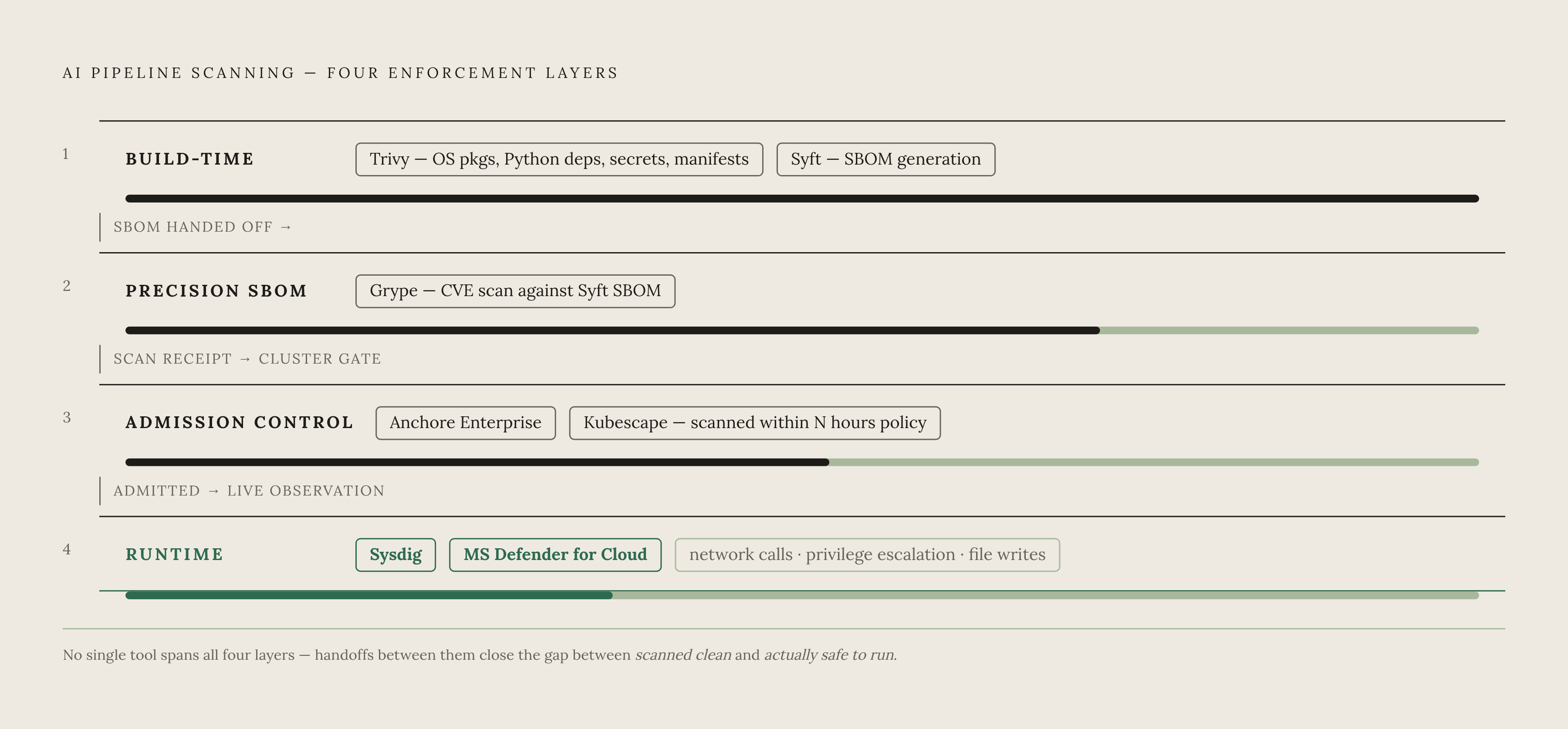
Line the pieces up and a pattern falls out on its own. Trivy runs first, at build time, as the fast all-in-one pass: OS packages, Python dependencies, secrets, manifests, all in one CLI step inside CI. Syft generates the SBOM alongside it for the images that matter most, base model images and training job images being the obvious candidates. Grype runs against that SBOM as the precision pass, catching what Trivy's broader database might have flagged loosely or missed outright.
That covers the image itself, but it says nothing about what happens once the image is actually deployed, and that's where admission control picks up: Anchore Enterprise or Kubescape sitting at the cluster boundary, enforcing that only scanned, policy-compliant images get admitted, and that the scan behind that decision is recent, not stale. AccuKnox fits here too, for teams running air-gapped or on-prem GPU clusters where cloud-dependent tooling simply isn't an option.
Runtime monitoring picks up from there, running continuously against workloads already live. Sysdig and Microsoft Defender for Cloud both work this space, watching for the network calls, privilege escalations, and file writes that only show up once code is actually executing, exactly the behavior no static scan could have predicted ahead of time.
Underneath all three layers sits the traceability question: OX Security's link from vulnerability to commit to developer, plus the signed SBOM archive that lets a team answer "which images contain this package" without re-scanning a single thing.
No single tool on this list covers all four layers well, and chasing one scanner to rule the whole pipeline is the wrong instinct. This gap is a fair reflection of how much ground an AI pipeline image actually spans, from a training job's Python dependency tree to a GPU driver installed by runfile to a model generating its own code at inference time. What works is mapping which tool covers which layer, and wiring the handoffs between them so nothing falls into the gap between "scanned clean" and "actually safe to run."