Secrets Management for AI Agent Sandbox Environments
How AI agents break traditional secrets management and what to fix before production.

Secrets management for AI agents needs a different model than the one built for traditional application security, because the old model assumes a human somewhere in the loop, and agents just don't work that way. I've spent enough time debugging leaked credentials in sandbox environments to know where this actually breaks: at the injection boundary, in the isolation layer, and in the gap between how long a credential lives and how long an agent session actually runs. This piece walks through each of those failure points, starting with where the leaks happen and ending with what I'd actually check before shipping an agent sandbox to production.
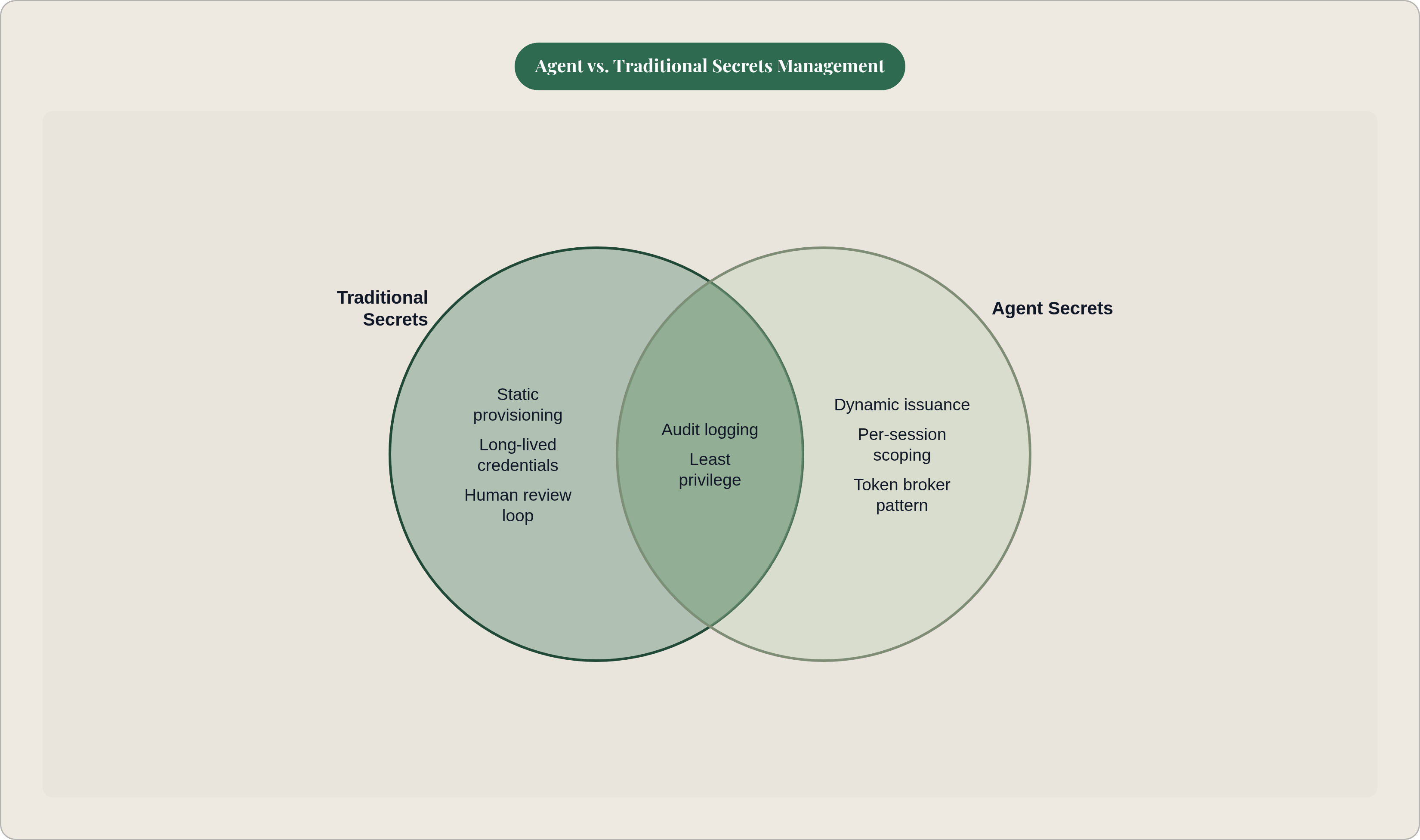
Traditional secrets managers, things like HashiCorp Vault, CyberArk Conjur, or AWS KMS, were built on three assumptions that made sense for a decade of application security: secrets get provisioned once and rotated on a schedule, workloads stay in roughly the same context over their lifetime, and somewhere in the process a person is watching. Agents break all three at once. They act in real time, in contexts that shift call to call, often with nobody reviewing what they're doing until well after the fact. Aembit's analysis of this shift doesn't mince words: that combination demands identity-aware, dynamic access decisions, not a vault sitting behind a static provisioning step. Timing matters here too. Daytona estimates at least 164 trillion sandbox sessions will run annually within three years, and every one of those is a place where a secret can walk out the door.
So what actually changes when you move from a service account model to an agent model? The agent itself becomes the workload identity, but that identity is a lot harder to pin down than a server's IP address or a static service account ever was. Credentials get consumed programmatically, often with zero human review in the loop, and a single agent session might call a dozen or more outside services, each wanting its own credential on its own terms. The sandbox running all of it is untrusted by design: nobody sat there and read the code executing inside it line by line, and often it can't be fully audited before it runs at all. This isn't a review of secrets managers as a product category. It's about how secrets get into a sandbox, how they move once they're there, and what has to be true of the environment to keep them from getting out.
Where secrets actually leak in agent sandbox environments
Start with scale, because the numbers here aren't small. GitGuardian's State of Secrets Sprawl 2026 found 29 million new hardcoded secrets in public GitHub commits during 2025 alone. Commits made with the help of AI coding assistants leaked at roughly double the base rate of everything else. That's not a rounding error. It's a signal that the tools writing more of our code are, right now, also writing more of our leaks.
The MCP configuration file problem makes this concrete in a genuinely uncomfortable way. GitGuardian found around 24,000 secrets sitting in MCP config files on public GitHub, and a lot of them followed the official documentation to the letter. The documentation itself was teaching people the wrong pattern; thousands of developers just did exactly what they were told to do.
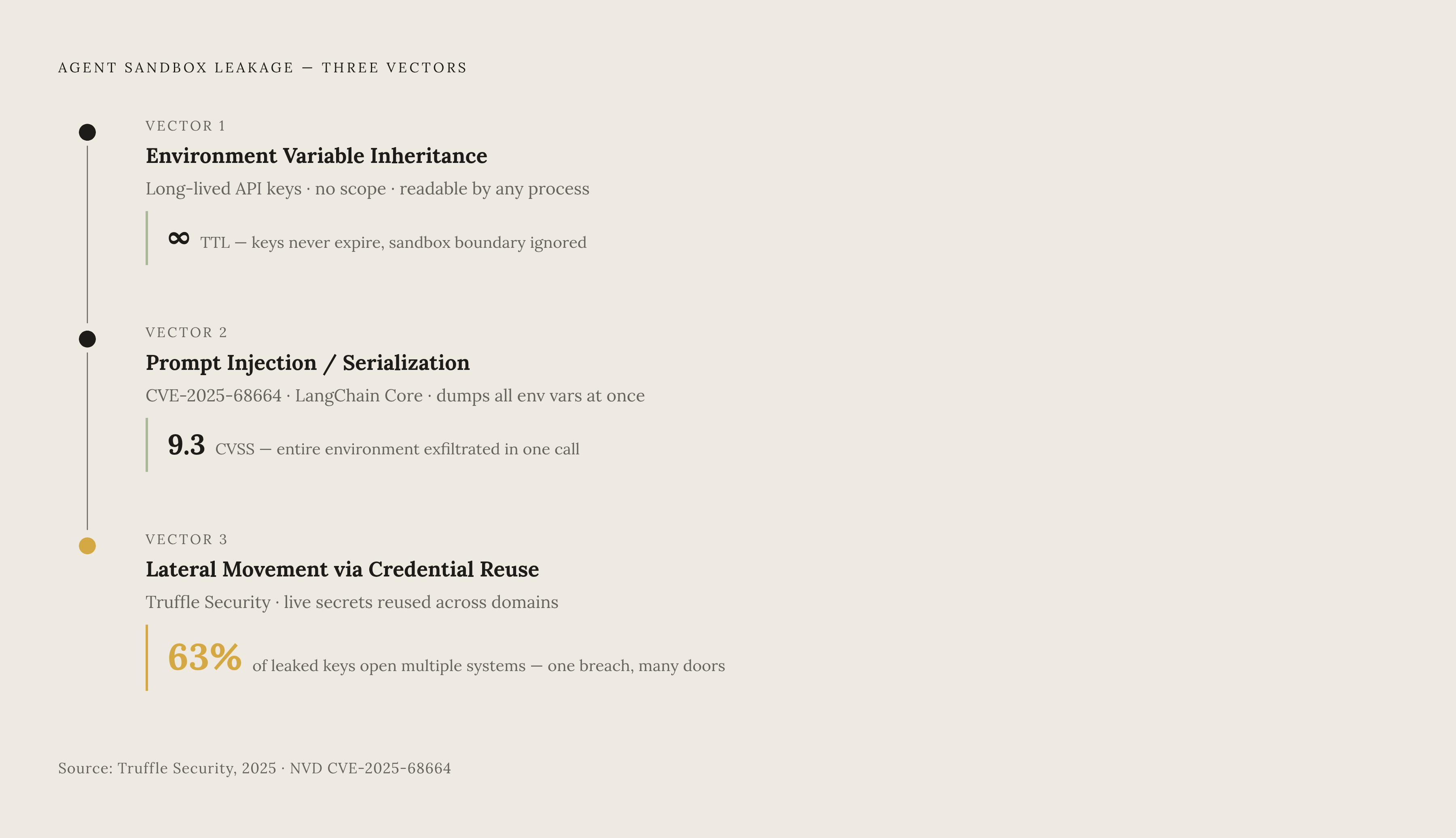
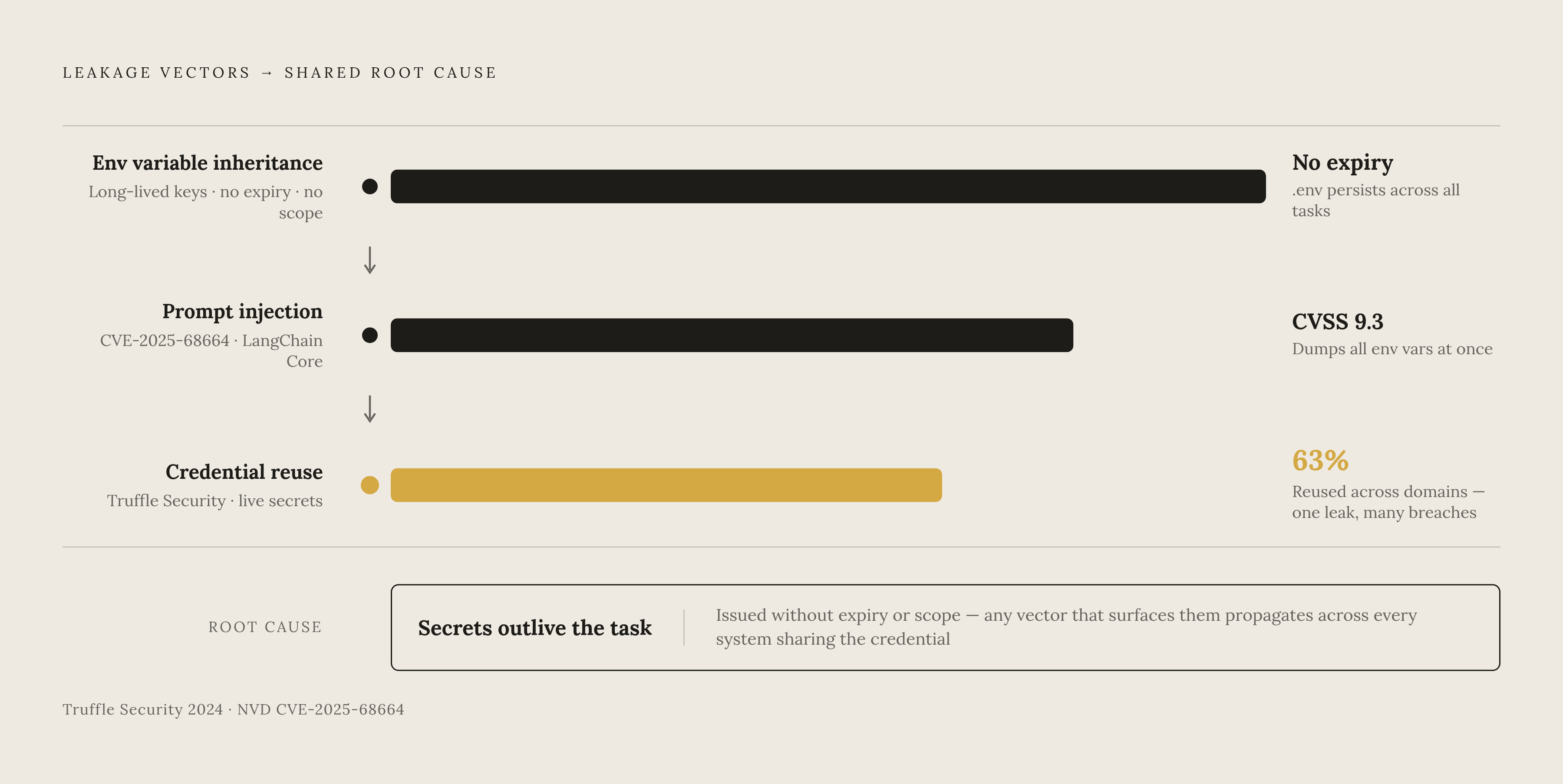
Three leakage vectors keep showing up in agent sandboxes. Environment variable inheritance is the most common one: a long-lived API key sitting in a .env file or injected at startup, no expiration, no scope limits, no separation between environments. The same key that runs a harmless read-only lookup can also write to production, and sandboxing alone doesn't fix that. Even a sandbox properly isolated at the process level can still exfiltrate a secret handed to it as an environment variable, unless network egress is locked down and those variables get actively scrubbed after use rather than left sitting there for anyone to find.
Prompt injection and serialization attacks are the second vector, and they expose something structural, not just risky, about the environment-variable pattern. CVE-2025-68664 in LangChain Core, rated CVSS 9.3, let an attacker craft a prompt that triggered the serialization system into dumping environment variables wholesale. Every secret stored there got exposed in one shot. Hard to find a clearer illustration of why "just put it in an env var" can't be the answer for any workload running arbitrary or AI-generated input.
The third vector is lateral movement once a credential gets compromised. A company with 400 developers scanning its repositories for the first time typically turns up over 1,000 unique leaked secrets it didn't know existed. Truffle Security's scan of Common Crawl's web dataset found close to 12,000 live secrets, and 63% of those keys were reused across multiple domains. Reuse is what turns one leak into a dozen breaches; if an agent gets compromised and that one key opens ten doors instead of one, the attacker inherits all ten of them.
What ties these three together? Every one traces back to secrets that outlive the task they were issued for, and that travel inside the agent process instead of staying safely outside it. Fix that, and most of this sprawl problem stops being a problem worth losing sleep over.
The injection boundary: where secrets must stop before they reach the agent process
NVIDIA's AI Red Team put the principle plainly: don't expose secrets at rest, and don't expose them to the environment either. Injecting secrets as environment variables is standard practice for a normal web app. It becomes insecure the moment that workload starts executing arbitrary code, because arbitrary code can read its own environment without asking permission.
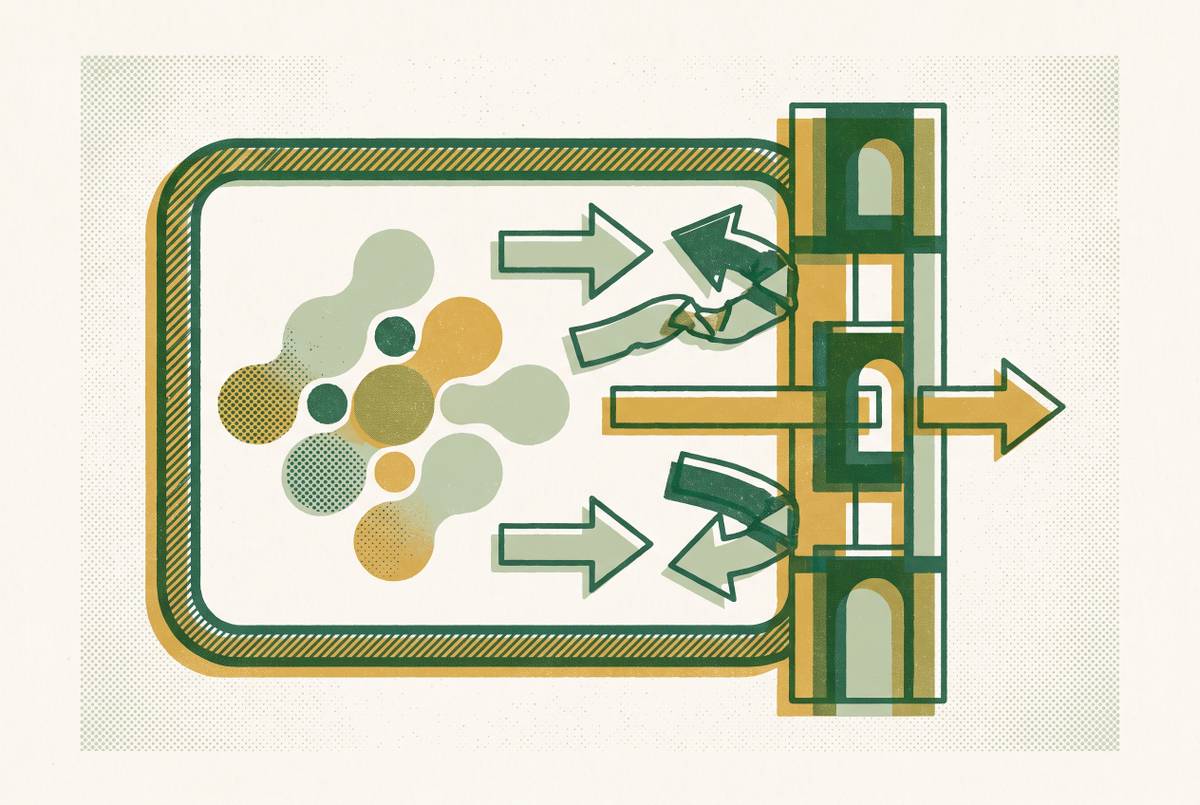
The sidecar or middleware pattern is the fix that's actually held up in practice. Secrets live in a layer outside the agent process, a sidecar or middleware service the agent talks to but never touches directly. The agent process itself holds no credentials, so even a fully compromised agent has nothing to exfiltrate. Credentials get fetched on demand, scoped tightly to the one call being made, and they never sit in the agent's memory or its environment variables waiting to be found by whoever comes looking.
A well-designed injection boundary keeps the sandbox itself credential-free: no API keys, no database credentials, nothing an attacker could use directly even reading the full environment. Credentials live in a control plane outside the sandbox, passed in only as minimal, scoped references, and those references get scrubbed from the process environment immediately after first use. The injection surface doesn't just start small; it actively shrinks after first use.
What does the sandbox runtime need to pull this off? Network egress controls, so a secret can't be transmitted outbound even if it somehow does get accessed. Process-level isolation, so a child process spawned by the agent can't inherit the parent's full environment by default. And a clean split between the control plane, which holds credentials, and the data plane, where the agent's actual code runs.
None of this bolts onto a generic Docker container after the fact. The injection boundary has to be part of how the runtime gets designed from day one, or it isn't really a boundary at all.
Dynamic, short-lived credentials as the operating model for agents
Dynamic access management gives you things a static vault structurally cannot. Credentials get issued at the moment of the request, not preloaded at startup. They're scoped to exactly the task at hand, so a read-only lookup gets a token that can only read. They're bound to context, meaning which agent, what purpose, which environment, which human delegated the action, and they expire in seconds or minutes rather than sitting valid for days or years. Every issuance carries an audit trail explaining what got granted and why.
The token broker pattern is how this gets implemented in practice. A dedicated broker service checks the agent's identity and the current task context, then issues a least-privilege, short-lived token and nothing more. NVIDIA recommends this pattern explicitly for agentic workloads running arbitrary code, for good reason: the broker lives outside the sandbox, as part of the control plane, so it's never exposed to the code it's handing credentials to.
Agent identity is, honestly, the hard part of this whole picture. An audit trail that only shows which service account acted isn't enough anymore. You need the agent's identity, the identity of the human who delegated the task, the session context, and a record of what got touched, all of it tied together. Multi-agent systems make this harder still, because a credential chain might pass through three or four agents before it reaches the outside service it's meant to authorize, and each hop has to preserve the original identity without quietly escalating it along the way. Per-agent, per-session credential scoping is what stops one compromised agent from dragging down every other agent's access with it.
Multi-tenant isolation adds another layer on top of all this. Different customers' credentials need to be encrypted with different keys, full stop, so a compromised key for customer A never becomes a door into customer B's data. Those encryption keys should be managed separately from the data they protect, ideally backed by a hardware security module or a cloud KMS rather than sitting in the same store as everything else.
How sandbox isolation technology determines what secrets can and cannot escape
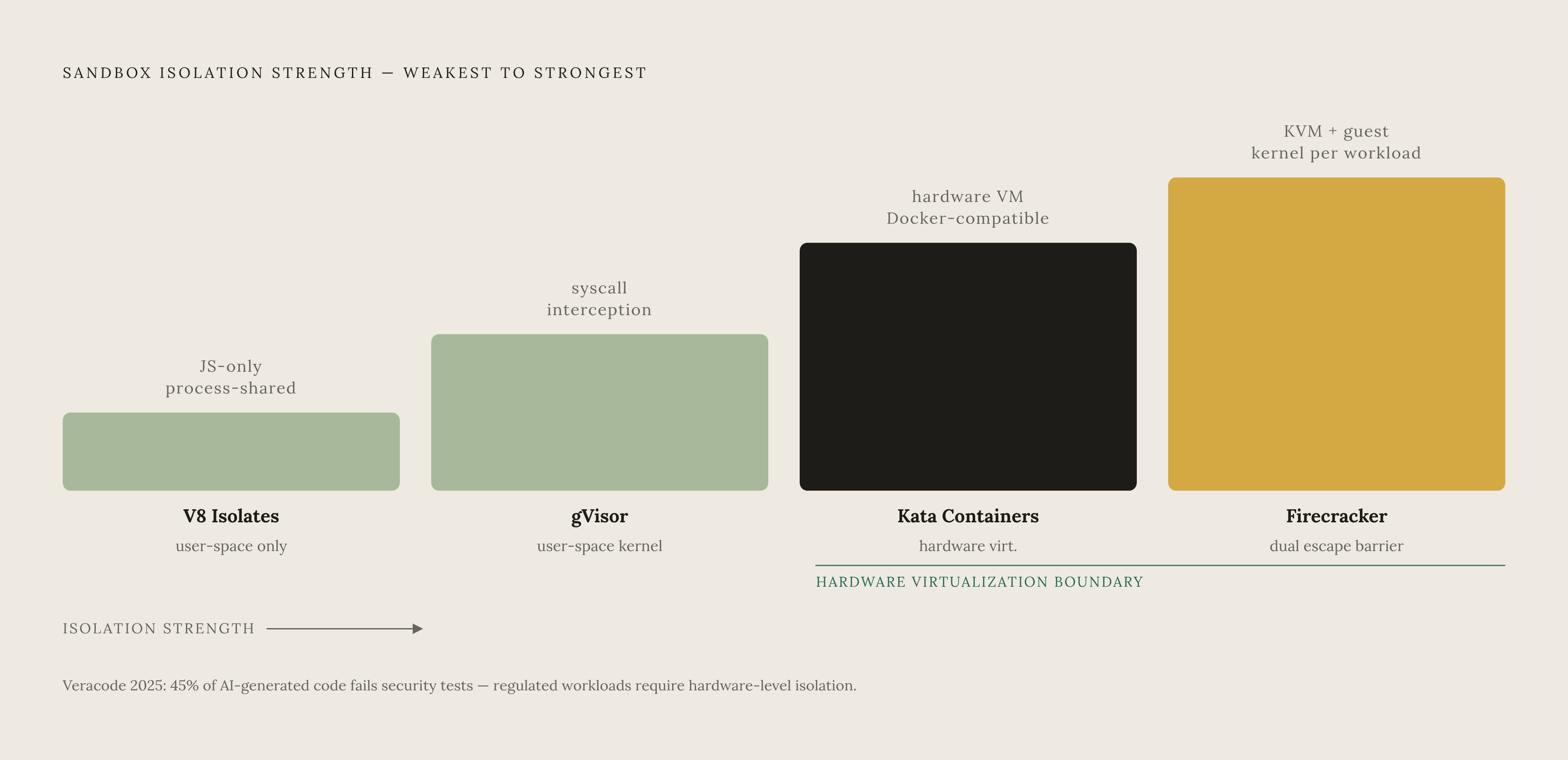
Veracode's 2025 report found that 45% of AI-generated code fails security tests outright. That's the baseline threat model any isolation layer has to be built to contain, and it's worth sitting with: nearly half the code an agent might write or execute has a real security flaw somewhere in it.
Standard containers aren't enough of a boundary for this kind of exposure. They share the host kernel, and as gVisor's own documentation puts it, with a standard container the workload sits one system call away from compromising the host. A secret injected into a container that manages a kernel-level escape was never really contained in the first place. Security profiles like seccomp, Linux capabilities, or mandatory access control narrow the surface, but they don't close off kernel-level escape paths entirely.
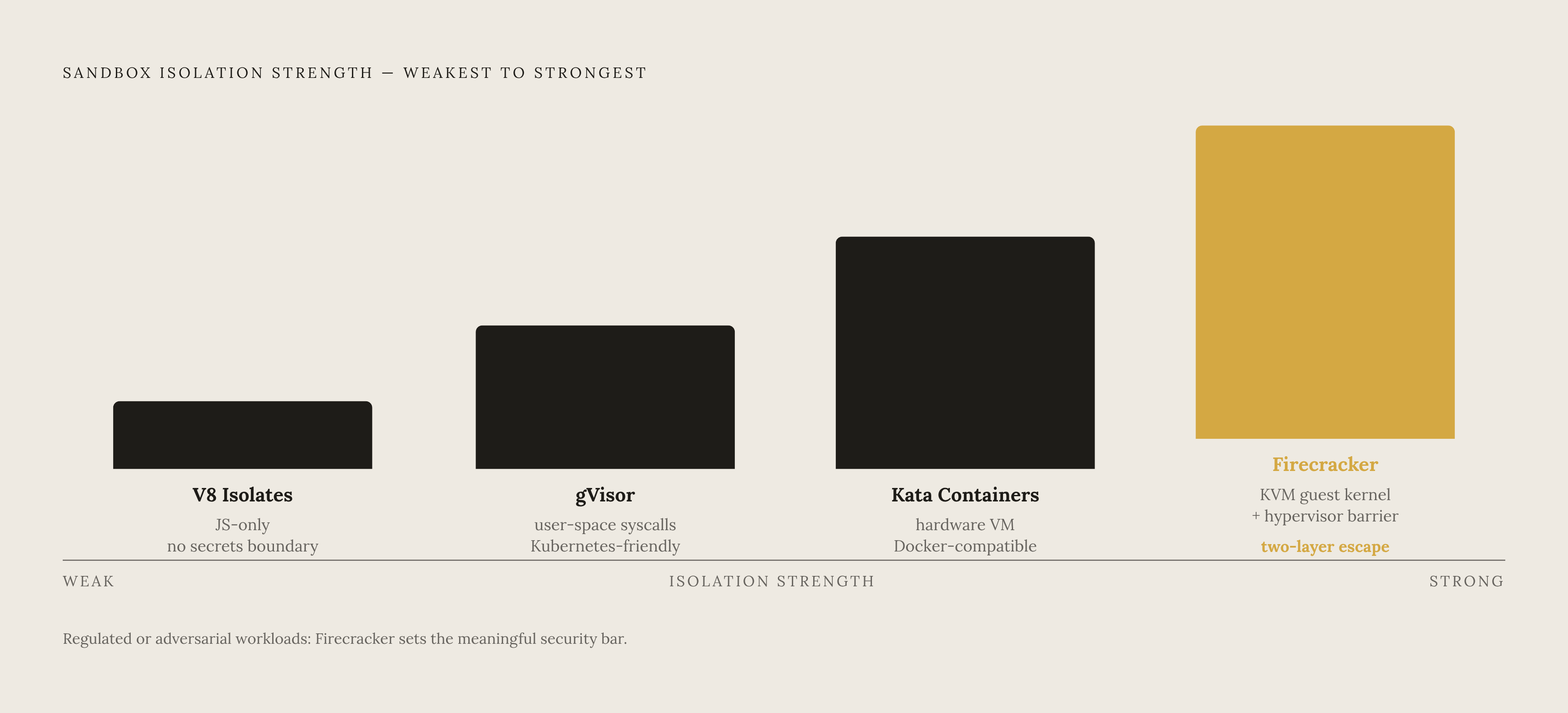
The isolation options available today land at pretty different points on this spectrum. Firecracker, AWS's open-source VMM written in Rust, builds lightweight virtual machines on top of KVM hardware virtualization, so each workload gets its own dedicated kernel; escaping means breaking both the guest kernel and the hypervisor layer above it, which is the meaningful security bar for regulated workloads or anything running adversarial code. Kata Containers offers similar hardware-virtualization isolation while staying Docker-compatible, which suits teams already living in the Docker ecosystem. gVisor intercepts system calls in user space, working well for compute-heavy Kubernetes deployments but without the same hardware isolation boundary Firecracker gives you. V8 Isolates are fine for lightweight, JavaScript-only tasks, but they aren't a general-purpose secrets boundary and shouldn't get treated as one.
Major agent platforms have landed in different places here. Claude Code uses Bubblewrap on Linux and Seatbelt on macOS, though the strength of that boundary depends on how the runtime is configured and deployed. OpenAI's Codex uses Landlock and seccomp, representing a stricter default posture for sandboxing among major agent platforms. Daytona offers teams a route from container-native development toward hardware-level isolation in production, giving teams a path to stronger isolation without rewriting their whole stack.
Isolation technology, then, isn't a deployment preference you pick based on convenience. It determines whether the injection boundary and the dynamic credential model described above can actually hold once someone's trying hard to break them.
Secrets in stateful and long-running agent sessions
Ephemeral sandbox models solve a lot of problems. They don't solve this one. Platform timeout limits reflect a synchronous HTTP world that agent work has already outgrown: Vercel caps functions at a few minutes, Lambda hard-limits at fifteen. An agent that loses its state loses its credential context right along with it. Session tokens expire, ephemeral credentials don't refresh themselves, and resuming a session might require re-authenticating in a way the agent has no ability to pull off on its own.
Checkpointing raises its own version of this problem. A snapshot meant to capture an agent's memory and state has to be built so it never captures live credentials in the process; secrets need to be stripped out of serialized state entirely, or swapped for references that only get re-resolved when the session actually resumes. The authority to reissue credentials belongs with the control plane, not the sandbox itself. The sandbox should show up on resume, present its identity, and get handed fresh credentials, rather than trying to replay whatever it had stored from before.
Rotation is where this gets genuinely tricky. A credential that expires in sixty seconds makes total sense for a quick task. It's a real headache in a session running six hours straight, and the runtime has to handle silent reissuance in the background without ever interrupting the agent mid-task. Which argues for the token broker itself being session-aware: it needs to know which sessions are still live and proactively refresh their credentials before the clock runs out, rather than waiting for a failed call to notice something expired.
Sandboxes built to run indefinitely, the kind where an agent picks a task back up exactly where it left off hours or days later, need a secrets layer built around that same expectation of persistence. Credentials that can get re-materialized on demand whenever they're needed beat credentials handed over once at the start and then forgotten until something breaks.
Enterprise compliance requirements that secrets handling in agent sandboxes must satisfy
Gartner projects that 33% of enterprise applications will include agentic AI by 2028, up from less than 1% in 2024. That's a genuinely fast curve, but full production deployment today sits at only 11%, and part of that gap is simply that risk controls haven't caught up with how fast the ambition moved.
Each major compliance framework asks something specific of the secrets layer, worth naming separately rather than lumping together. SOC 2 wants access controls, audit logs for every credential access event, and evidence that least privilege is actually enforced rather than just claimed; that means an audit trail showing agent identity and delegating user identity together, not a bare service account name with nothing behind it. HIPAA treats encryption at rest and in transit for credentials touching protected health information as addressable, meaning strongly recommended though not strictly mandated, alongside access limited to only the specific process that needs it and audit trails detailed enough to reconstruct exactly what an agent touched and when. GDPR adds data residency requirements for where encryption keys and credential stores physically live, pushes toward customer-managed keys so one tenant's compromise can't spill into another's data, and requires demonstrating that credential access matched the stated purpose and nothing more.
Gartner also estimates that 40% of agentic AI projects will be canceled by the end of 2027, citing escalating costs, unclear business value, or risk controls that never got built out properly. Inadequate secrets handling is exactly the kind of concrete failure that lands a project in that last bucket. It's rarely the flashy AI mistake that kills a rollout; it's the boring infrastructure gap nobody closed in time.
The audit log bar sits genuinely higher for agents than it ever did for traditional applications. A standard service account log just isn't enough. The log needs to capture which agent acted, which human authorized it, what session it happened under, and precisely what got accessed, all tied together into one coherent trail. In multi-tenant deployments, those logs also need to be isolated by tenant, so one customer's audit trail can never leak visibility into another customer's activity.
Running agent workloads on compute inside the customer's own cloud is one practical way to satisfy a lot of this at once. It keeps credential storage and access logs inside the customer's own control perimeter, which speaks directly to GDPR's data residency demands and to any organization operating under stricter data sovereignty rules.
Practical checklist for secrets management in a production agent sandbox deployment
A few things I'd actually check before anything ships.
Keep secrets out of the agent process entirely. Route them through a sidecar, middleware layer, or broker sitting outside the sandbox, so a compromised agent has nothing sitting in memory to hand over to whoever's asking.
Issue credentials dynamically and scope them tightly. Short-lived, task-specific, tied to a real identity chain that includes both the agent and the human who delegated the work, not a static key that outlives the task by weeks.
Match the isolation technology to the actual threat model, not just developer convenience. Hardware virtualization through Firecracker or Kata Containers for adversarial or regulated workloads; lighter options only where the risk genuinely warrants it.
Build session persistence and credential rotation together from the start. Long-running or checkpointed sessions need fresh credentials reissued automatically on resume, instead of stale tokens sitting around in a serialized snapshot somewhere waiting to expire quietly.
None of these four pieces works alone. A broker issuing perfect short-lived tokens doesn't help much if the sandbox underneath it leaks kernel-level access to whoever's running the code inside it. Secrets management for agents is a design problem for the whole stack, not a single tool you drop in and call finished.