Confidential Computing Enclaves for Sensitive AI Workloads
Hardware isolation and attestation together protect AI models and prompts during processing.

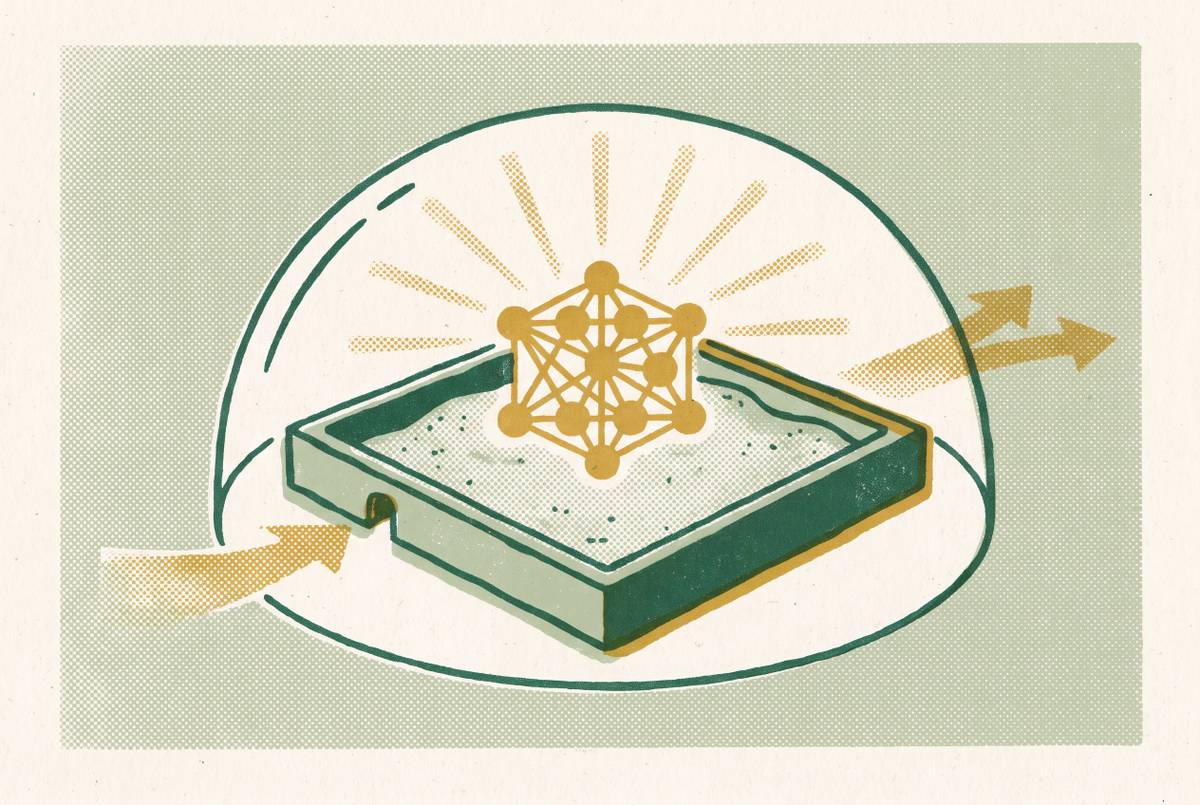
Confidential computing enclaves protect sensitive inputs, model weights, and outputs when AI processes them, where standard encryption leaves a gap. Their value depends on more than encrypted memory. A defensible confidential AI pipeline combines hardware isolation, continuous attestation, and protected I/O, with explicit limits on what the system promises.
The encryption gap that exposes AI workloads during processing
Data has three states, but conventional encryption protects only two. At rest, data is protected by AES-256 and access controls. In transit, data is protected by TLS as it moves between systems. During processing, though, conventional environments depend on access controls while the data sits in plaintext memory. The gap opens precisely when a model needs its inputs.
For sensitive AI, that window exposes more than a single record. Inputs, weights, and outputs can be accessible to the host OS, hypervisor, infrastructure administrators, or an attacker able to obtain a memory dump or perform a cold-boot attack. Proprietary weights can be exposed during every inference call. Prompts containing medical records, financial transactions, legal documents, or classified inputs introduce a separate confidentiality risk, including leakage across shared infrastructure.
What does storage encryption prove once inference begins? It does not establish that the infrastructure processing the request cannot inspect it. For workloads where that distinction is tolerable, conventional controls may suffice. For sensitive AI, protection during execution becomes an engineering requirement separate from storage security.
How a Trusted Execution Environment closes the gap
The Confidential Computing Consortium defines confidential computing as “the protection of data in use by performing computation in a hardware-based, attested Trusted Execution Environment (TEE).” A TEE establishes a hardware-enforced boundary around computation, excluding the host OS, hypervisor, and cloud operator from protected memory. The boundary changes who must be trusted. The system uses silicon-enforced isolation so it depends on more than infrastructure administrators following access policies.
Three properties make this useful for AI. Encryption protects model weights in memory against inspection from outside the enclave, while attestation provides cryptographic evidence about the environment executing them. Sealed-key release then makes access to secrets conditional on that evidence. Keys and encrypted model material are available only after the environment passes the required checks.
These properties depend on a chain of evidence. CPU silicon manages ephemeral memory-encryption keys that remain invisible to the host hypervisor, while memory protections resist inspection and tampering. Attestation certificates trace back to root keys from the hardware manufacturer. A Key Management Service can therefore withhold credentials until measurements match the authorized configuration, including the approved workload.
The guarantee has boundaries from the outset. An enclave does not protect plaintext outputs after they leave it, make a compromised signed image trustworthy, or automatically isolate every peripheral. CPU side channels also remain a concern. Confidential computing is consequently a system property that requires more than a vendor offering encrypted memory.
The three CPU hardware paths in production and how they compare for AI
In 2026, CPU deployment choices include Intel TDX, AMD SEV-SNP, and cloud implementations that package confidential execution in different operational forms with distinct security boundaries. Their relevance to AI depends on how workloads migrate, how evidence is verified, and how secrets reach the protected environment.
Intel TDX, or Trust Domain Extensions, runs a full virtual machine inside an encrypted Trust Domain that excludes the host hypervisor. It ships on select SKUs of 4th-generation and every 5th-generation Xeon Scalable data-center CPU. Intel Trust Authority, once known as Project Amber, uses a hardware root of trust for attestation. The migration model is familiar for VM-based teams. They boot a confidential VM much as they would a normal VM, then verify its quote before connecting.
AMD SEV-SNP, or Secure Encrypted Virtualization, Secure Nested Paging, is available on EPYC 9004, known as Genoa, and EPYC 9005, known as Turin. SNP adds memory integrity protection to SEV’s encryption, addressing ciphertext-replay attacks associated with earlier SEV-ES parts. Existing EPYC deployments offer a natural starting point. Firmware remains part of the security decision, however, because AMD’s 2024 and 2025 advisories identify fixes tied to specific revisions. Teams should check their BIOS, firmware, and hypervisor combination against the relevant bulletins.
Azure offers confidential VMs based on Intel and other processors, SGX enclaves, confidential containers on AKS, Managed HSM running in TEEs, and Microsoft Azure Attestation. Google Confidential GKE places Kubernetes workloads on confidential VMs. AWS Nitro Enclaves provide isolated environments within EC2 instances, with no persistent storage, restricted networking, and cryptographic attestation before sensitive material is decrypted. These options bring confidential execution into familiar deployment systems, but CPU protection alone is insufficient for LLM inference at scale.
Why GPU confidential computing changes what is possible for LLM inference
The missing boundary is the accelerator itself. LLM weights reside in GPU memory, and protecting CPU memory does not protect either that memory or the transfer path to it. NVIDIA introduced GPU confidential computing with the Hopper architecture, including H100 and H200. This extends confidential execution to the hardware doing the model’s intensive computation.
The distinction between isolation and encryption is essential here. Hopper protects PCIe traffic between CPU and GPU enclaves using a hardware session key, but H100 HBM memory itself is not encrypted. Blackwell introduced HBM encryption. It would therefore be inaccurate to describe H100’s protected execution as keeping all weights encrypted in GPU memory.
Attestation must extend across that boundary too. NVIDIA Remote Attestation Service, or NRAS, evaluates device proofs and returns a signed result, complementing CPU verification. EnclaveX, a 2026 research system from TU Dresden, STACKIT Cloud, and Scontain GmbH, demonstrates a composed pipeline using Intel TDX, NVIDIA H200, and the SCONE runtime for Kubernetes-native workflows.
Commercial offerings are following that architectural direction. Vast Data announced DataEnclave in September 2026 to run AI on sensitive data with NVIDIA confidential computing technology. General availability is scheduled for Q1 2027 through Vast and hardware partners including Cisco and Supermicro. Yet available hardware does not establish a trustworthy deployment by itself. The system must prove which CPU, GPU, and workload will receive the secrets.
Remote attestation in practice: where most teams underinvest
Before decryption keys are made available, verification must show that the expected binary is running on genuine TEE-enabled hardware with current microcode. The key service must then bind release to that approved configuration. Without that link, encrypted memory and secret delivery work as separate controls.
For implementation teams, this means treating attestation as an ongoing orchestration responsibility. A valid boot quote is not enough. Kubernetes admission controllers provide a common pattern for rejecting pods whose quotes have expired or whose measurements differ from the signed image. Re-attestation belongs in the orchestrator, while image signing belongs in the CI/CD pipeline that supplies approved workloads.
The verification service must match the hardware. Intel Trust Authority supports TDX workloads, AMD’s SEV attestation service supports the AMD path, and NRAS supplies GPU verification within NVIDIA’s attestation tooling. Cross-platform services can abstract over CPU vendors, but the manufacturer-rooted evidence remains essential. Key release should depend on measurements matching authorized manifests.
What happens after the verified workload produces an answer? A log, database, or downstream API needs encrypted storage, mTLS connections, and strict egress controls beyond the memory protection covered by attestation. The operational boundary therefore includes both the evidence that admits secrets and the handling that protects results after execution.
Trust model limits: what confidential enclaves do not protect
Attestation establishes the identity and configuration of approved code. If a compromised build pipeline produces a malicious signed image, its measurements can match perfectly. Supply-chain integrity is therefore a separate trust dependency that requires protection beyond stronger memory encryption.
Microarchitectural attacks create another limit. Spectre-class issues and timing side channels persist even with 2026 microcode, so exclusion of the host hypervisor does not imply immunity to every CPU-level attack. Peripheral access also requires separate treatment. Devices that lack IOMMU isolation remain outside the intended protection model, and attaching them does not automatically extend the enclave boundary. Together with output handling, these leave four areas to plan for, namely side channels, peripherals, the software supply chain, and post-enclave I/O.
Some privacy requirements call for complementary cryptography. Secure Multi-Party Computation, or SMPC, partitions data into mathematical shares distributed across independent nodes, allowing collaborative computation without any party viewing raw inputs. Cross-corporate fraud scoring and model-training consortia fit that pattern. Fully Homomorphic Encryption, or FHE, addresses a different question by allowing computation directly over ciphertext, with clients decrypting results. Its production implementations combine specialized accelerators with schemes including BFV, BGV, CKKS, and TFHE.
These tools complement TEEs by addressing related trust problems beyond the scope of hardware isolation alone. The practical implication is to reserve confidential computing for workloads whose privacy guarantee justifies its operational demands. Most experimental research, consumer chatbot traffic, and internal-use AI do not need the same architecture as clinical inputs or proprietary weights protected from infrastructure operators.
How confidential computing satisfies HIPAA, GDPR, and the EU AI Act's data-in-use requirements
The compliance value of confidential computing is evidence about processing. HIPAA’s technical safeguards include access controls and integrity controls. An attested TEE can demonstrate that access to protected health information is restricted to authorized code executing in a verified environment. That is stronger evidence than a promise from an administrator alone.
This does not establish compliance by itself. The GDPR and EU AI Act case likewise concerns demonstrable protection and governance, rather than treating a TEE as a complete legal answer. The EU AI Act’s high-risk categories increase the importance of provable privacy controls, while scrutiny of clinical AI and state-level privacy requirements adds pressure around sensitive processing. The technical architecture must still account for the limits already identified.
Healthcare networks, financial institutions, and government agencies now often ask AI vendors in security questionnaires what they can do with confidential computing. Confidential computing capabilities are becoming a contractual consideration. For vendors handling sensitive data, an auditable protection boundary can therefore affect whether an inference service is acceptable to a buyer.
Employees who send sensitive information through unauthorized tools take it outside the governed environment entirely. Anthropic, OpenAI, and Google offer enterprise compliance coverage including HIPAA BAA signing and GDPR Data Processing Addenda, but none is HIPAA-compliant by default. Plans and settings remain consequential, so vendor certifications cannot substitute for evaluating the actual processing arrangement.
Building a confidential AI inference pipeline: the evaluation and deployment checklist
Evaluate five deployment dimensions together, namely hardware, attestation continuity, I/O boundaries, workload scope, and runtime infrastructure. CPU inference on existing Xeon or EPYC infrastructure can follow the corresponding TDX or SEV-SNP path, while container pipelines can use the cloud implementations described above. GPU inference needs a composed boundary such as the architecture demonstrated by EnclaveX, with generation-specific protections stated accurately.
Attestation evaluation should connect build approval to runtime admission. Teams should sign enclave images in CI/CD and make the orchestrator reject expired quotes or unapproved measurements. Key-release policy must consume that evidence. This links the software the organization approved to the environment receiving its sensitive material, rather than leaving approval and deployment as separate assertions.
Boundary evaluation should follow the data out of execution. Encrypted downstream storage, mTLS, and strict egress access logging belong in that assessment, together with IOMMU isolation for attached peripherals. Scope should be equally explicit. Clinical PHI, financial PII, and proprietary model weights can justify these controls, while applying them indiscriminately adds complexity without proportionate benefit.
Runtime infrastructure completes the evaluation around the enclave. AI execution needs isolation, state, fast provisioning, and a way to run long-running agent workloads without losing state. Customer-managed compute keeps inputs, weights, and outputs under organizational control, complementing TEE isolation. Open-source, inspectable infrastructure also reduces the opaque trust dependencies surrounding the protected workload.
Before sign-off, teams should establish that the attestation chain is inspectable, the operator retains no uninspected access, and the I/O path is explicitly hardened. “Confidential by name is not confidential by guarantee.” The engineering work lies in proving the difference.