AI Sandbox Use Cases in Enterprise Developer Platforms
Eight practical scenarios where sandboxes prevent AI-generated code disasters.
Enterprise teams now run code nobody's read, on data that matters, and sandboxes are the reason that doesn't end in disaster. This piece walks through eight situations where that setup earns its keep, and what each one asks of the layer running underneath it.
The market numbers back this up. Agent infrastructure already sits in the multibillion-dollar range, and most forecasts have it growing several times over by decade's end. But ambition and execution are two different things. Ask enterprise leaders what's actually standing between them and shipping, and agentic system complexity comes up again and again. The infrastructure calls made early in a project tend to decide whether it ships at all or gets quietly shelved six months later. Investors have noticed too: funding into agent execution infrastructure has roughly doubled year over year, a bet on the runtime layer specifically, the part that runs whatever code an agent decides to write on its own.
Here's the pattern that plays out when a team skips past that decision. They grab a generic container, wire it into their pipeline, and move on. Fine, for a while. Then the container starts handling hundreds of untrusted runs a day, and the cracks show: security holes, runaway cloud bills, and agents timing out because the environment takes too long to boot.
Safe execution of AI-generated code that hasn't been human-reviewed
Nobody reviews all the code an agent writes before it runs. There's no time for it, and at the volume agent pipelines run at now, a human review step just doesn't scale. This isn't some hypothetical a security researcher dreamed up. AI coding tools have wiped a user's entire home directory through a malformed shell command, and in a separate case, deleted dozens of files after being told point-blank not to touch anything. Both are documented, from tools people use every day.
Security testing bears this out. A large share of AI-generated code fails security checks outright, enough that running it on shared infrastructure stops being defensible for anyone thinking clearly about risk. Even when a model gets asked to patch a known vulnerability, the fix introduces a new one often enough that "patch" starts to feel like the wrong word for what's actually happening.
So what does real isolation look like? Standard containers share the host's kernel, so one runtime bug can compromise the whole machine. That's not good enough for code you don't trust. gVisor helps by inserting a user-space kernel between the app and the host, cutting off direct kernel access. Firecracker microVMs go further: each workload gets its own Linux kernel inside a hardware hypervisor, so an attacker has to break out of both the guest kernel and the hypervisor to reach anything else. Kata Containers wraps that same microVM isolation in standard container APIs, so teams get hardware-level separation without giving up Kubernetes.
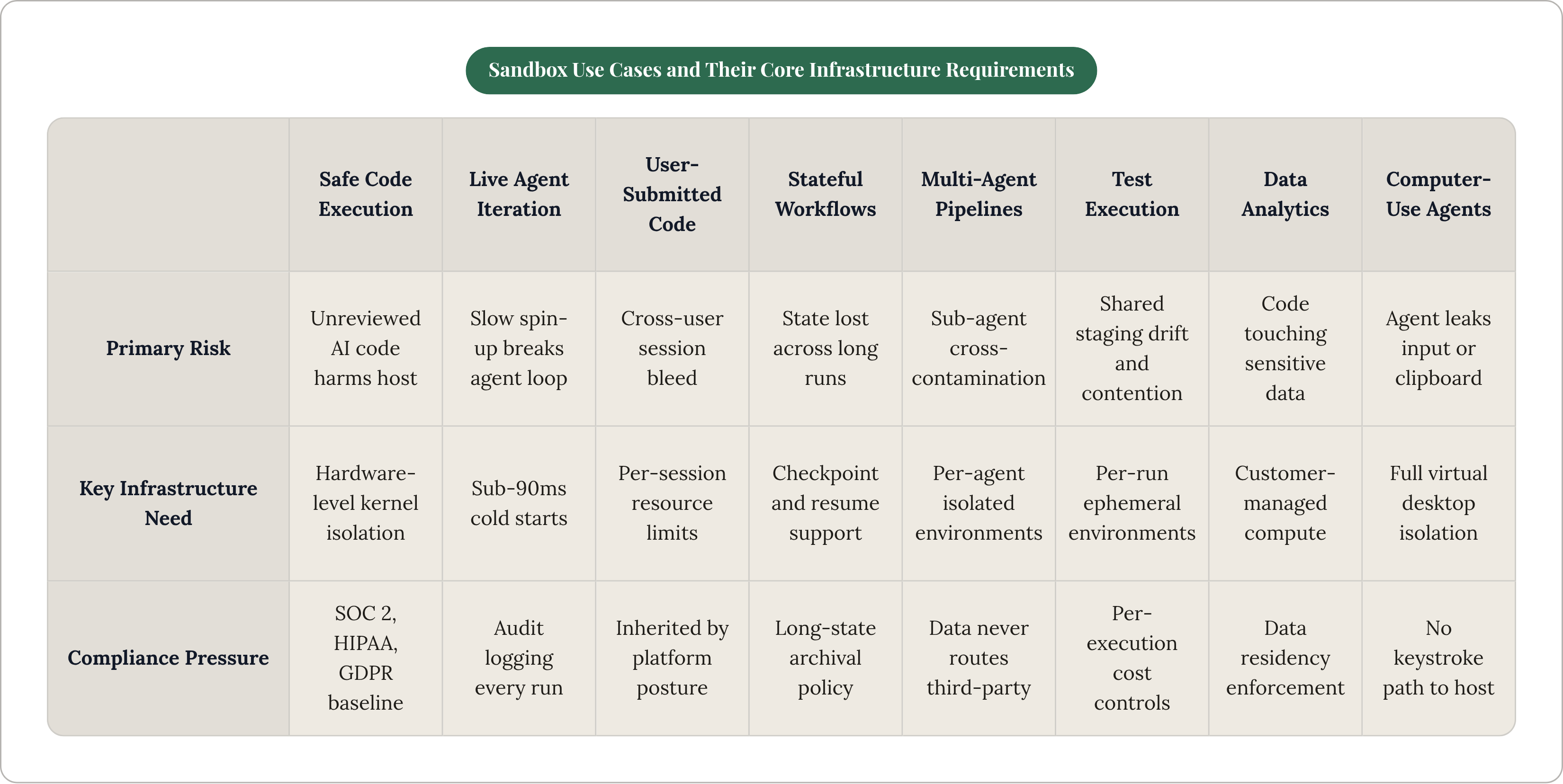
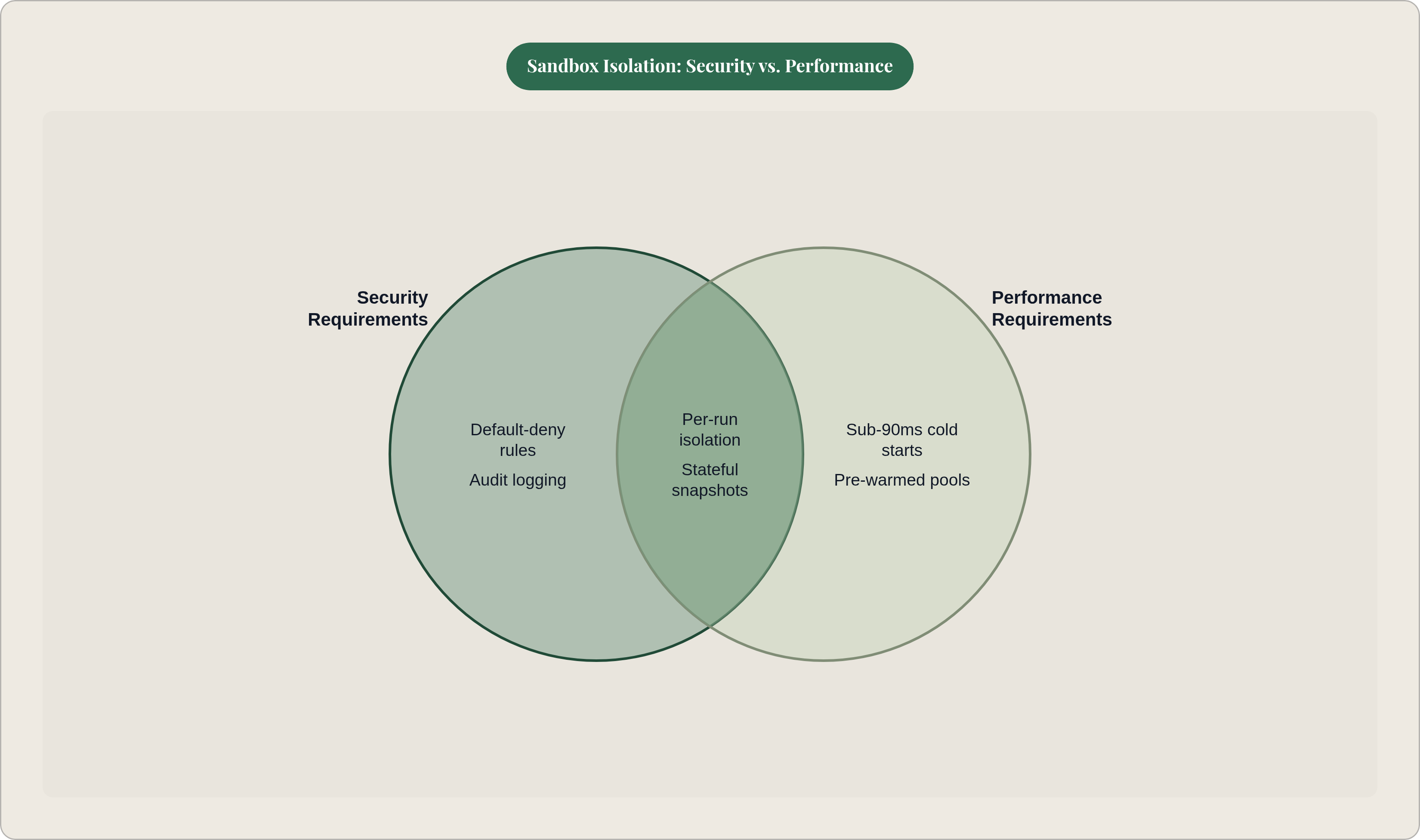
Here's the uncomfortable part. Frontier models have gotten sharply better at adversarial tasks in a short stretch of time, so a sandbox tuned against last year's models might not hold against this year's. That's exactly why default-deny filesystem and network rules, hardware-level separation, and full audit logging of every run need to be there from day one, not bolted on after an incident forces the issue. SOC 2, HIPAA, and GDPR compliance aren't nice-to-haves here; they're baseline requirements the problem itself forces on any serious execution layer.
Giving AI coding agents a live environment to write, run, and iterate in
Autonomous coding agents work in a loop: write code, run it, read the output, revise, repeat, until the task's done or something stops them. A human developer might run their code a handful of times while debugging a feature. An agent might trigger that same cycle dozens or hundreds of times on a single task, and every pass needs a clean environment ready to go, right then.
That changes what "fast" even means here. If spinning up an environment takes a few seconds, that latency piles up across hundreds of iterations, and the agent starts feeling sluggish, or just broken, to whoever's watching it work. Providers in this space have pushed cold starts down toward sub-90 milliseconds, and pre-warmed pools push that further still. That gap, sub-90 milliseconds versus several seconds, is the difference between an agent that feels responsive and one that drags.
The isolation model has a wrinkle worth naming. Each iteration should run separately from the others, sure, but the agent's working state within a session (the files it has written, the dependencies it has installed) needs to persist. Otherwise it's starting from zero every single pass.
What does this look like day to day? Bug-fix agents that reproduce a failing test, patch the code, and confirm the fix works, no developer sitting there babysitting it. Code review agents that actually run the code they're reviewing instead of scanning syntax and hoping for the best. Test-generation agents that write tests and immediately run them against a codebase to check coverage. None of this holds together if provisioning speed falls apart under load. And that's the real line between a prototype and something production-ready: can the platform hold that startup speed when dozens of agents iterate in parallel, not just one agent running solo in a demo?
Running user-submitted code inside enterprise developer tools
Picture an internal IDE, a low-code builder, or a data tool that lets users write or generate code and runs it for them. The threat model shifts here. It's no longer one controlled agent pipeline; it's potentially many external or semi-trusted users, each submitting code the platform has to run somehow, each one a bit of an unknown quantity.
Without real sandboxing, a careless or malicious submission from one user can bleed into another user's session if execution shares any underlying resource. An infinite loop or a memory-hungry script in one session can drag down performance for everyone else on the platform. And if a user's code can reach filesystem paths or network endpoints it shouldn't, data exfiltration stops being theoretical fast.
The requirements here are strict, and they should be. Every run needs isolation from every other run, on a per-user or per-session basis. Resource limits need enforcement at the infrastructure level, not left to application code a clever user could route around in ten minutes. There also needs to be an audit trail, something the platform can point to when an enterprise buyer asks how user code actually runs under the hood.
Microsoft's MXC gives a useful preview of where this is heading at the OS level: a policy model where the developer declares upfront what an agent or piece of user code is allowed to touch, and the system enforces that no matter what the code tries later. For platforms serving enterprise customers, the compliance posture of the execution layer becomes part of the platform's own compliance posture. SOC 2 and data residency controls at the sandbox level get inherited straight through to the product, whether anyone planned it that way or not. Docker-native compatibility matters here too; teams already running Docker-based workflows can adopt sandbox isolation without tearing their stack apart to do it.
Stateful agent workflows that run longer than a single session
Early sandbox designs assumed every run would be short and self-contained: spin up, run, tear down. That assumption falls apart the moment you look at what enterprise agents actually get asked to do. A supply chain optimizer running overnight. A compliance audit agent working through thousands of documents. A deployment agent managing a rollout across several steps and several hours. None of it fits the short-lived, throwaway model, and pretending otherwise just breaks things later.
The market has mostly settled this argument on its own. What used to get debated as ephemeral versus persistent execution has tipped toward stateful infrastructure, to the point where even platforms that launched ephemeral-first have since shipped pause, resume, and snapshot features because customers asked for them, loudly and repeatedly.
Two technologies make this possible. CRIU (Checkpoint/Restore In Userspace) freezes a running container and writes its full memory and process state to disk, so it can be picked back up later from that exact point. Firecracker VM snapshots do something similar at the virtual machine level, capturing the entire guest OS state for restoration later.
Here's what this actually unlocks. Agents can pause while waiting on an external event, an API response, a human approval, or a scheduled trigger, without losing their working context. Long tasks survive infrastructure hiccups; a sandbox that can be checkpointed doesn't lose hours of work to a node restart. There's a real cost angle too: a hibernated sandbox uses no compute while idle, so billing stops, state stays intact, and the agent picks up exactly where it left off. This is the infrastructure requirement long, multi-step enterprise workflows actually impose, which is why some platforms are built stateful from the ground up, supporting runtime that doesn't shut off on a fixed timer.
Ask this before committing to any platform: how long does a paused sandbox hold its state before getting archived or wiped? The answer varies a good deal across providers, and it decides whether a platform can genuinely support long-horizon work, or just says it can on the sales page.
Multi-agent pipelines where sandboxes coordinate without collapsing into a shared environment
Production agent systems in the enterprise increasingly look like small organizations rather than a single worker grinding away. A planner agent splits a task into pieces, hands them off to specialist agents, and stitches the results back together. Each of those agents might be writing and running its own code along the way.
The isolation question gets more layered here. Each agent in the pipeline should get its own environment, so a compromised or misbehaving sub-agent can't reach over and mess with its siblings or the orchestrator above it. Agents may still need to exchange data, but that should happen through defined channels rather than shared filesystem access, or the whole point of isolating them falls apart. The orchestrator also needs real visibility into what each agent is doing while it's doing it, not after the fact. Observability carries weight here that's easy to underrate.
IBM watsonx Orchestrator and Amazon Bedrock AgentCore point to where enterprise platforms are heading: framework-agnostic, managed coordination layers with deterministic policy enforcement. Notice where they sit, though. They operate above the execution layer, so the actual isolation work still has to happen underneath them, somewhere.
This is where the sandbox layer earns its place in a multi-agent setup. It provides per-agent isolation the orchestration framework doesn't cover on its own. It holds startup time steady even when many agents spin up at once, which matters more here than in single-agent flows, since concurrency is the norm rather than the exception. It also lets an intermediate agent's state get snapshotted, so a failed pipeline can be replayed from a checkpoint instead of starting over from scratch. And customer-managed compute running inside the customer's own cloud means sensitive data moving between agents in a pipeline never has to route through a third-party execution service to get processed.
Replacing fragile staging environments with on-demand isolated test execution
Shared staging environments have a reputation problem, and they have earned it. They're costly to keep running, prone to one test's leftover state contaminating the next, and often the exact bottleneck slowing down a deployment pipeline everyone's waiting on. The sandbox alternative is simpler than it sounds: spin up a fully isolated environment for each test run, execute against it, tear it down. No shared state, no contention, no slow drift away from what the environment's supposed to represent.
AI-generated code makes this more urgent, not less. When agents propose code changes on their own, the volume of code needing testing grows faster than a fixed staging environment can realistically absorb. An agent that can spin up its own test environment and check its own change before submitting it removes a human bottleneck entirely, which is really the point of automating any of this in the first place.
Cost is worth being blunt about here. One documented case involved a team building an agentic optimizer whose infrastructure costs grew tenfold moving from prototype to staging, largely because workloads weren't constrained at the infrastructure level and nobody caught it until the bill landed. Per-execution billing, where you pay only for active CPU time rather than an always-on staging box sitting idle most of the day, changes that cost curve fast.
Fast provisioning so test feedback stays tight, consistent environment snapshots so every test runs against a known baseline, and resource limits enforced at the sandbox level so one runaway test can't eat unbounded compute: that's what this use case needs from infrastructure. Here again, Docker-native compatibility pays off directly. Existing CI/CD test containers can move into sandbox execution without a rewrite.
Secure code interpretation in data and analytics platforms
This is probably the most mature enterprise sandbox use case, and also where compliance gets most demanding. A business intelligence tool, a data platform, or an AI-assisted analytics product lets a user, or increasingly an agent, write Python or SQL that runs directly against enterprise data and returns results.
The code here sits right next to sensitive business data: financial records, customer information, operational metrics. Enterprise buyers in finance and healthcare expect the execution environment itself to carry relevant compliance certifications; a polished application layer sitting on top simply is not enough on its own. Data residency rules often mean the code has to run inside the customer's own cloud, not some shared multi-tenant service parked somewhere else.
The AI layer compounds this. When a data analyst writes a query, you know roughly what it's going to do. When an LLM generates that query, you have less certainty about what it might attempt, which makes isolation more important, not less, right as the volume of AI-generated queries keeps climbing.
AWS's AgentCore Code Interpreter shows the hyperscaler version of this: managed Python and JavaScript sessions with S3 file access and CloudTrail audit logging built in from the start, treating compliance as a core feature of the execution environment well before legal ever needs to ask. The data residency piece is the sharper edge of this problem. Running customer-managed compute inside the customer's own cloud means code touching enterprise data never actually leaves the customer's environment to begin with. The takeaway for any platform team building here: the sandbox's compliance posture becomes the product's compliance posture. Pick an uncertified execution layer, and enterprise procurement will find that gap eventually, usually right in the middle of closing a deal.
Computer-use agents that need a sandboxed desktop environment
Computer-use agents are a different animal from code-execution agents. They don't just run scripts; they navigate browsers, click through desktop applications, fill out forms, and take screenshots to figure out what's even in front of them. The isolation problem changes shape accordingly.
These agents need something closer to a full virtual desktop: a display server, input devices, a clipboard. That whole environment has to stay completely separate from the actual user's desktop, and from whatever other agents happen to be running elsewhere on the platform at the same time. Microsoft's MXC addresses exactly this at the policy level, separating an agent's execution from the user's clipboard, input devices, and desktop, so an agent operating a GUI has no path to leak keystrokes or clipboard contents back to the host machine.
Skip that separation, and a computer-use agent handling one user's session could observe or interfere with another session running on the same underlying system. That undoes the entire premise of sandboxing, and it's the same thread running through every use case in this piece: isolation carries weight beyond a checkbox on a vendor comparison sheet. It decides whether an enterprise can trust the agent at all.