Differences Between AI Sandboxes and Traditional Application Sandboxes
AI agents demand isolation from the kernel itself, not just from each other.

Traditional sandboxes did not emerge from abstract security theory. They emerged from a specific, practical problem: analysts needed a controlled place to detonate suspicious files without putting production systems at risk. The conceptual lineage traces back to Unix chroot in the late 1970s, which changed the apparent root directory for a process, preventing it from traversing the broader filesystem. It was a jail, crude but effective. Decades later, that idea matured through Linux namespaces, containerization, and eventually the orchestration layers we now call Docker and Kubernetes.
NIST SP 800-83 defines a sandbox as a controlled environment that restricts what operations applications can perform and isolates them from other applications on the same host. That definition is deliberately spare, but the engineering underneath it is layered. Linux namespaces extended the chroot concept beyond the filesystem to process IDs, user IDs, and network interfaces, forming the conceptual backbone of modern containers. Control groups (cgroups) enforce hard resource quotas on memory, CPU, network, and disk I/O. seccomp-BPF restricts which system calls a process may make; in its most restrictive configuration, only read, write, exit, and sigreturn are permitted, and violations trigger SIGKILL. Windows and macOS implement equivalent logic through different APIs: Job Objects, Integrity Levels, and AppContainers on Windows; TrustedBSD-based mandatory access control on macOS.
No single primitive is sufficient. Real sandboxes combine them so that a failure in one layer does not expose the host. Browsers formalized this into the broker-process model: renderer processes hold no direct system access and must request resources through a more privileged broker that enforces per-request policy. The defense-in-depth is deliberate.
The core use case driving all of this is analyst-submitted triage. An analyst submits a file. The sandbox detonates it. The analyst reads a behavioral verdict. The model assumes a known, static artifact. The sandbox's job is observation and containment, not ongoing collaboration.
Buried in that workflow is a critical assumption that rarely gets stated explicitly: the workload is a static binary whose system-call surface can be meaningfully enumerated before execution begins. You can write a seccomp policy because you have, or can infer, a reasonable picture of what the process will try to do. That assumption holds when the artifact is fixed. When the workload is a generative agent deciding at runtime what to do next, it doesn't.
Why AI-generated code invalidates the static threat model
In traditional sandboxing, the code under analysis exists before the sandbox does. The environment can be tuned to what is already known. AI-generated code is produced at runtime. The sandbox must contain something that did not exist when it was configured, which makes behavioral pre-enumeration not just difficult but structurally impossible. You cannot write a seccomp policy for code you haven't seen yet.
Veracode's 2025 report found that a substantial share of AI-generated code fails security tests outright, meaning a significant fraction of what agents produce is exploitable on arrival. That figure alone would stress any review pipeline. Volume compounds it further. One major coding tool alone reportedly accepts close to a billion lines of code daily. No analyst-driven triage workflow was designed to operate at that scale, and sandboxes built around that workflow inherit its assumptions about throughput.
Prompt injection sharpens the problem into something the old model has no frame for. An attacker embeds malicious instructions in a tool description, a data field, or an external document the agent reads during normal operation. The agent, following those instructions in good faith, executes arbitrary actions using its own legitimately granted permissions. No exploit is required. The threat arrives as semantic content, not as a malicious binary.
Traditional sandboxes have no analogue for this. Their entire monitoring apparatus, syscall tracing, file operation logging, network capture, is oriented toward observable binary events. Meaning is not a category they reason about. When an agent reads a compromised document and then begins exfiltrating data as a direct result, the system calls involved may be entirely ordinary. Nothing in the traditional stack flags the transaction as hostile.
Agentic deployments also invert the classical access model. In traditional sandboxing, code execution inside the container is a thing an attacker is trying to obtain through exploitation. In an AI sandbox, code execution is granted by design. The question shifts from whether the agent can get in to whether it can get out.
The isolation technologies AI sandboxes actually use
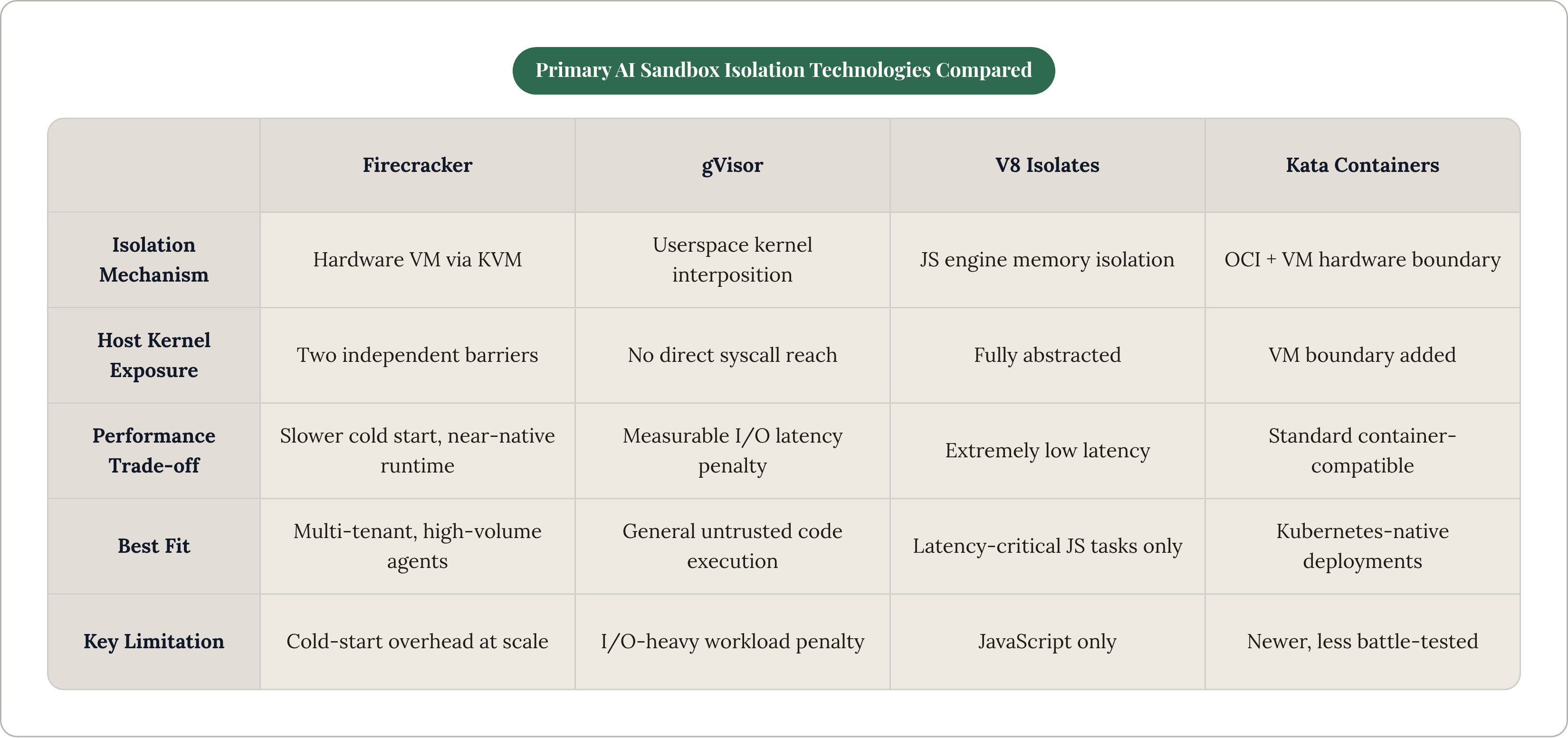
Standard containers share the host kernel. For workloads executing untrusted, LLM-generated code, that shared surface is too large. The community has converged on three primary isolation technologies, each occupying a different point on the isolation-to-performance curve.
Firecracker, open-sourced by AWS and used in Lambda and Fargate at scale, creates minimal virtual machines backed by KVM with hardware-enforced isolation via Intel VT-x and AMD-V. A guest cannot reach the host kernel without first escaping the VM boundary, then escaping a secondary seccomp jailer layer: two independent barriers. Cold starts are faster than traditional VMs but slower than plain containers. Runtime performance is near-native. Memory overhead per microVM is small enough to support high-density multi-tenant deployments, which matters when agents run in parallel at volume.
gVisor, developed at Google and used in Cloud Run and GKE Sandbox, interposes a userspace kernel between the workload and the host. System calls are intercepted and served by gVisor's own Go-implemented kernel, never reaching the host kernel directly. This reduces the host attack surface considerably. The trade-off is latency: I/O-heavy workloads carry a measurable penalty from the interception layer.
V8 Isolates are JavaScript-only, extremely low latency, and lightweight. They are the right tool for latency-critical, JS-constrained tasks and a poor fit for anything outside that narrow boundary.
Kata Containers, maintained by the OpenInfra Foundation, combines OCI-compatible container interfaces with VM-level hardware isolation. It supports standard images and Kubernetes pod specifications while adding a VM boundary that standard container runtimes omit.
The pattern across all of these is consistent: AI sandboxes add a hardware or kernel-emulation boundary that traditional container stacks deliberately omit for performance reasons. That omission was a reasonable engineering trade-off when the workload was a known, trusted application. It is a different calculation when the workload is generated at runtime by a model operating with tool-use permissions.
GPU isolation is an additional requirement with no traditional-sandbox parallel. AI inference workloads need GPU access, and that access must be isolated alongside CPU and memory. The primitives for doing this are newer and less battle-tested than their CPU-side counterparts.
Stateful sessions versus ephemeral detonation
Traditional sandboxes are ephemeral by design. Detonate, observe, discard. State persisting between runs is a bug, not a feature, because persistent state is a vector for contamination across analyses. The clean-slate guarantee is part of what makes the verdict trustworthy.
AI agents working on complex tasks accumulate state that has genuine value: conversation history, installed packages, crawled datasets, partial work products. Resetting state between sessions forces the agent to reconstruct its context from scratch, which defeats much of the productivity case for agentic workflows. The stateful model is not a security compromise teams accept reluctantly; it is often a product requirement.
Platform session policies reflect fundamentally different design philosophies. Some platforms are built around stateful sandboxes that can run indefinitely, offering one-hour sessions on base plans and twenty-four-hour sessions on higher-tier plans. Northflank permits unlimited session duration. These are not arbitrary product choices; they encode assumptions about what kind of work the platform expects agents to do.
Statefulness introduces security considerations that simply do not arise in ephemeral models. Persistent state can accumulate sensitive data across sessions: credentials, API keys, user content. Long-running agents have more time and more opportunity to attempt escape or to accumulate capabilities through installed packages. The threat model in a forty-eight-hour stateful session is structurally different from the one in a sixty-second detonation environment. Both require isolation; they do not require the same kind.
This is one of the cleaner examples of where the two sandbox paradigms diverge not just in degree but in kind. The ephemeral model treats time as the enemy of clean analysis. The stateful model treats time as a productive resource and manages the security implications that follow from that choice.
Escape vectors specific to AI sandboxes
Traditional sandbox escapes exploit kernel vulnerabilities or misconfigured primitives. They are well-characterized, heavily researched, and largely addressed by the hardware boundaries described above. The vulnerability landscape for AI sandboxes is younger, moves faster, and includes vectors that have no traditional analogue.
CVE-2026-25049, scored at CVSS 10.0 and affecting the n8n workflow automation platform, illustrates how quickly complexity compounds. Researchers at Pillar Security identified a chain of three JavaScript sandbox flaws: a template literal bypass, exploitation of prepareStackTrace, and an arrow function oversight. Together, the chain allowed arbitrary system command execution, decryption of all stored credentials, and access to internal Kubernetes infrastructure. Each flaw was modest; the chain was catastrophic.
CVE-2026-5752, scored at CVSS 9.3 and affecting Cohere AI Terrarium, involved prototype chain traversal in a Python sandbox that enabled arbitrary code execution with root privileges on the host process. CVE-2025-12420, affecting ServiceNow Now Assist at the same severity, took a different path entirely: low-privileged users embedded malicious instructions in data fields, higher-privileged agents later processed those fields, and those agents then recruited even more capable agents to perform unauthorized actions including administrative role assignment. The propagation path moved laterally through the agent hierarchy, which has no meaningful equivalent in traditional sandbox architecture.
Supply chain exposure compounds the picture. Campaigns documented in late 2025 compromised a meaningful number of npm packages specifically targeting AI agent workflows. Without network egress restrictions, agents that install packages pull these payloads automatically, without any prompt injection or exploit required.
The escape surface is not static. Task completion capability for frontier models has been roughly doubling at a measurable pace, and evaluations show non-trivial success rates on real-world web application vulnerabilities. A sandbox adequate for today's models may be inadequate for the models running against it in eighteen months. HiddenLayer's 2026 survey found that roughly one in eight AI security breaches is now linked to an agentic system, and nearly a third of organizations cannot determine whether they experienced an AI breach at all. That last figure is the more troubling one. Containment controls are only valuable when you can tell whether they're working.
Security controls that AI sandboxes require and traditional ones don't
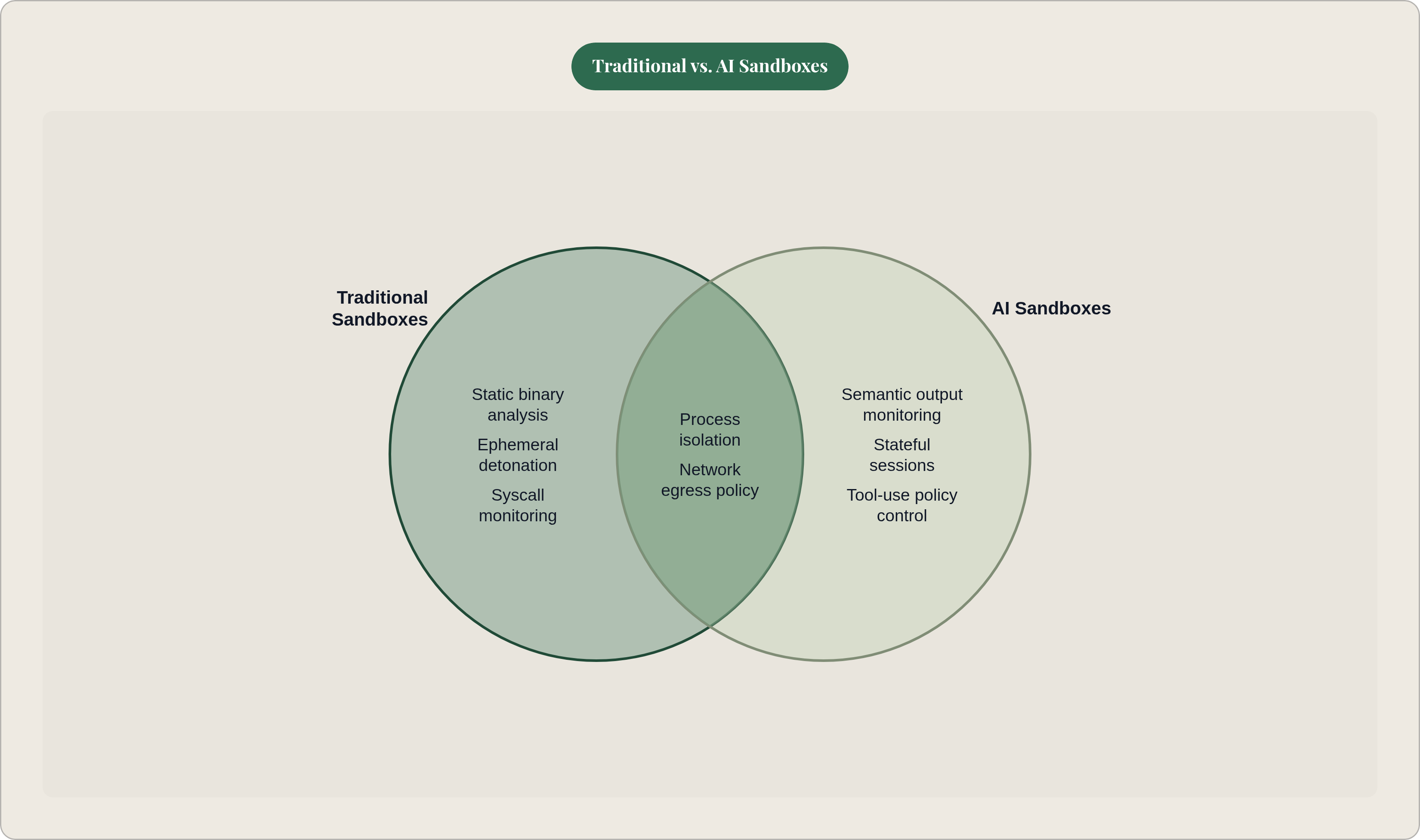
Network egress policy is the most immediately actionable control. The default posture in an AI sandbox should be no outbound access; allowlists for specific domains, package registries, and approved APIs are added explicitly. Without this, agents freely install compromised packages and exfiltrate data through ordinary outbound connections that no process-level control would flag.
Semantic output monitoring has no traditional-sandbox equivalent. Conventional sandboxes monitor system calls and file operations: observable, binary events. AI sandboxes must also monitor what the model produces. Outputs may contain harmful content, leaked credentials, or instructions that will be executed downstream by another agent or by a human operator who trusts the output. This requires a monitoring layer that understands natural language, not just syscall sequences.
Tool-use and Model Context Protocol surface control is increasingly necessary as agents invoke external tools through standardized interfaces. Each tool invocation is a potential injection point. Policy enforcement must operate at the tool-call level, not just the process level, because a well-contained process can still cause significant damage through a legitimately granted tool call that an attacker has misdirected.
Resource hard caps on CPU, memory, disk I/O, and process count prevent runaway agent code from affecting the host or neighboring sandboxes. GPU resource quotas are an additional dimension with no traditional-sandbox parallel. These are hygiene controls, but they become load-bearing when agents operate for extended sessions and their resource consumption is not bounded by any human interaction cadence.
Permission minimization deserves more design attention than it typically receives. Agents operating with broad permissions create a large blast radius on escape or misdirection. The irony is that sandboxing, by reducing the need for constant human permission prompts, can actually improve the incentive structure here: fewer interruptions means less pressure on developers to grant overly broad access as a workaround for operational friction.
Traditional sandbox controls address a bounded syscall surface. AI sandbox controls must address syscalls, network behavior, semantic outputs, tool invocations, and long-running stateful processes simultaneously. The monitoring and policy surface is qualitatively larger, not just quantitatively so.
What the divergence means for teams building or evaluating AI environments
The differences outlined above are not a matter of AI sandboxes being more rigorous versions of traditional ones. They address a different threat model against a different kind of workload. Treating containerization as sufficient for agentic deployments is not a minor gap in coverage; it is operating with a threat model that predates the workload being run.
Isolation technology selection involves real trade-offs that deserve explicit engineering discussion. Firecracker provides the strongest boundary at the cost of cold-start latency. gVisor reduces the host kernel attack surface with a measurable I/O penalty. V8 Isolates are appropriate for narrow, latency-critical, JavaScript-constrained tasks and nothing beyond them. The choice is not purely a security decision; it shapes what the platform can do and how it performs, which in turn shapes whether developers actually use the controls or route around them.
Session architecture, ephemeral versus stateful, is a product decision with security implications, not merely a performance preference. The choice determines what data persists, how long an agent can accumulate capabilities between checkpoints, and what must be protected across sessions rather than only during a single execution window. Teams that treat this as an afterthought tend to discover its implications during an incident rather than during a design review.
Supply chain and prompt injection vectors mean that network policy and tool-invocation controls deserve the same design attention as process isolation. These are not secondary concerns addressed after the perimeter is established; they are primary vectors through which the perimeter becomes irrelevant.
The HiddenLayer finding that a substantial fraction of organizations cannot determine whether they've experienced an AI breach points to a prerequisite that precedes every containment control discussed here: visibility. Logging and observability across agent sessions are not optional components to be added after deployment. Without them, you cannot evaluate whether your isolation is working, cannot bound the scope of an incident, and cannot improve your posture over time.
The CVEs documented in 2025 and 2026 are early entries in what will be a longer catalog. Model capability continues to expand the effective escape surface. What constitutes adequate isolation today is a floor, and it would be prudent to treat it as one.