MCP Server Sandboxing Isolation Requirements
Execution servers need isolation that API proxies don't, and most teams don't know the difference.
The premise most teams carry into their first MCP deployment is reasonable: a server is a server, a container is a container, and hardening practices transfer. They don't, and the failure tends to be quiet. The decisions that set the blast radius are made weeks before anything goes wrong, usually by people who didn't know they were making security decisions.
The error isn't configurational. It's categorical. Model Context Protocol is an interface layer standardizing how agents communicate with tools, data sources, and external systems. The protocol itself executes nothing. But a substantial share of MCP servers execute code on behalf of models, and that distinction reshapes what isolation requires in ways that standard hardening guides simply don't address.
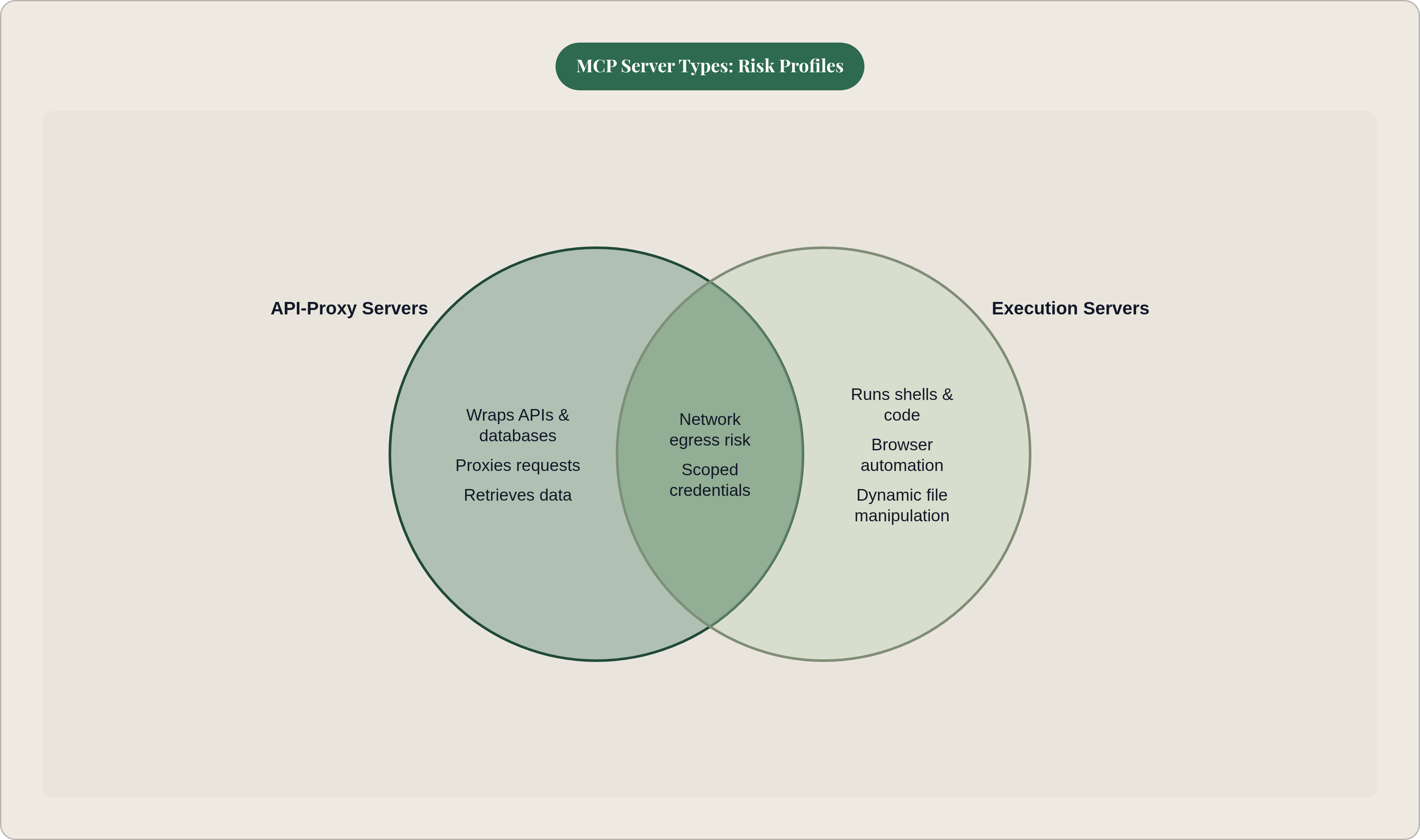
Two meaningfully different populations of MCP server exist in production. The first wraps APIs, databases, and SaaS tools; it proxies requests and retrieves data. The second runs shells, executes AI-generated code, launches browsers, or manipulates files dynamically. This second category is an execution environment, regardless of how the team describes it or how the protocol labels it. Teams reasoning from the first category's risk model while deploying the second category's capabilities are working from the wrong map, and they may not find out until they're reading an incident report.
The consequences aren't abstract. An MCP server that runs a shell without isolation can access unauthorized resources, affect adjacent workloads, or be turned against the infrastructure it was built to serve. The attack surface isn't hypothetical: multiple named CVEs appeared in the MCP layer within a single year, targeting the client, the server, and the protocol boundary between them. The ecosystem expanded rapidly through community contribution, and security review has struggled to keep pace. That's a predictable property of fast-moving open ecosystems under adoption pressure, not an indictment of anyone in particular.
The defining class of MCP-specific attack is tool poisoning. A poisoned tool description can direct an agent to exfiltrate data without user interaction; Invariant Labs demonstrated this publicly in early 2025. Three variants have been documented: tool description poisoning, rug-pull attacks in which a tool's behavior is silently changed after approval, and tool shadowing. OWASP has since codified tool poisoning as a named category in its MCP Top 10 project. When OWASP formalizes a threat class, the security community has reached rough consensus that the threat warrants structured treatment.
Over-privileging compounds everything. The official GitHub MCP server exposes a large number of tools, mixing high-risk operations like file deletion alongside benign ones. A model can invoke destructive capabilities that were never needed for the task at hand, simply because they were available. If the server runs without isolation, nothing separates what the model can request from what the infrastructure will execute.
Client-side risk belongs in any serious threat model, because teams tend to scope their analysis too narrowly to the server side. CVE-2025-6514 showed that mcp-remote passed server-provided data directly to the system shell, enabling remote code execution on the user's machine. The entire protocol boundary warrants scrutiny, not just server endpoints.
The architectural lesson that keeps reasserting itself across incident reviews: well-designed models follow malicious instructions embedded in tool output more reliably than they ignore them. The model is not a security boundary. The runtime has to be. Designing toward that conclusion isn't pessimism about AI; it's accurate threat modeling.
What the Official MCP Security Specification Actually Requires
The official MCP security specification does not hedge on the fundamentals. Server commands should run in sandboxed environments with minimal default privileges. Four controls are stated explicitly: restricted filesystem access, with read-only as the default and write access granted only to designated directories; network access constrained to an allowlist with default-deny egress rather than default-allow; resource quotas applied to CPU, memory, and disk so that a single server cannot consume shared infrastructure; and no inheritance of host credentials or environment variables.
Academic governance work, including research catalogued under arXiv:2511.20920, reinforces and extends the specification, recommending containers or virtual machines with strict isolation boundaries rather than process-level separation alone. The specification names containers, chroot, and application sandboxes as platform-appropriate options but deliberately leaves the technology choice open. That openness isn't a flaw in the document. It is, however, precisely the space where teams tend to under-implement, because "technology-agnostic" reads as permission to use whatever is already deployed.
What the specification leaves implicit is worth separating out. It doesn't mandate startup latency requirements, statefulness, or multi-tenant isolation. Those requirements emerge from production workloads, not from a protocol document written to define communication standards. A team that satisfies the specification's minimum controls and stops there may have satisfied protocol governance while remaining structurally unprepared for anything resembling operational scale.
The principle the specification states most clearly is also the one that tends to get summarized away in implementation discussions: the model can suggest what to ask for, but policy must enforce what actually happens. Collapsing that distinction is how well-intentioned deployments end up with an agent that can do more than anyone authorized.
Why Network Isolation Is the Gap Most Containerized Deployments Leave Open
Teams containerize their MCP servers and believe they've addressed the isolation requirement. In many cases, they've handled filesystem and process isolation while leaving egress entirely open. Default container networking doesn't constrain outbound traffic. An MCP server that can reach arbitrary internet destinations can exfiltrate data even when its filesystem access is locked down. The attack surface doesn't disappear; it relocates.
Default-deny egress requires three things that are all operationally inconvenient: an explicit allowlist of approved outbound endpoints defined before the server starts, enforcement at the network layer rather than by application logic, and logging of all network activity so that policy violations are detectable after they occur. For MCP servers calling external APIs on behalf of agents, the legitimate set of outbound destinations is usually small and knowable in advance. The discipline of defining and enforcing that list before deployment, rather than after something suspicious shows up in the logs, is where most teams fall short.
The over-privileging problem takes a specific form here. If a model can invoke a tool that makes arbitrary HTTP calls and egress is unrestricted, that tool is an exfiltration channel. Application-level fixes don't resolve this. Egress control has to be enforced by the infrastructure, not trusted to the server process and certainly not to the model directing it. Container defaults were designed for deploying applications the developer trusts; they were never designed for executing untrusted model-generated instructions. The gap isn't carelessness on the part of the container tooling. It's a mismatch of design intent that becomes a vulnerability when the workload changes character.
How Isolation Technology Choices Affect the Security Guarantees Teams Actually Get
The central axis when evaluating sandbox technology is the strength of the kernel boundary between the workload and the host. Everything else is secondary to that question.
Standard containers share the host kernel. A kernel exploit inside the container can reach the host. For trusted application workloads, that's an acceptable tradeoff; the isolation layer is meaningful even if the boundary isn't absolute. For servers executing AI-generated code, the trust assumption changes in ways that make the same tradeoff materially harder to defend. gVisor interposes a user-space kernel, reducing the host kernel's attack surface without the full overhead of a virtual machine. MicroVMs, implemented through technologies like Firecracker, Kata Containers, and libkrun, provide a dedicated kernel per workload. For MCP servers executing AI-generated code or running shells, microVM isolation is where the security guarantees become architecturally defensible rather than aspirational. The code is untrusted by definition, and the kernel boundary is where containment is actually enforced.
WebAssembly offers a different model. Each MCP tool compiles to a Wasm component; a policy file declares which filesystem paths, network hosts, and environment variables it can access. Wasmtime provides strong sandboxing. It also has a documented history of sandbox escape CVEs, including a Cranelift miscompilation vulnerability patched in early 2026. Teams relying on Wasm isolation for untrusted code should track the CVE stream actively rather than treat the technology as settled.
Docker containerization, as an entry-level approach, adds a meaningful restrictive layer. A compromised MCP server without containerization can reach host credentials, local filesystems, and potentially the broader corporate network. Containerization separates process space, filesystem, and networking from the host. That matters. But simple containerization alone doesn't satisfy production requirements; it lacks uniform policy enforcement, centralized credential management, and the scaling controls that multi-tenant deployments require.
Technology choice isn't reducible to security concerns alone. Startup latency, statefulness, and GPU access are real differentiators across isolation primitives. The appropriate choice depends on the workload profile of the specific MCP server in question, which argues for classifying the server before selecting the isolation technology, not the other way around.
The Requirements That Distinguish Production MCP Deployments from Sandboxed Pilots
Enterprise adoption of agentic AI has accelerated considerably, but the share of organizations that have moved beyond pilots to full production remains small. Infrastructure is consistently named as a barrier. The gap isn't primarily technical sophistication. The requirements for production are qualitatively different from what makes a pilot function safely, and teams sometimes don't encounter that distinction until they've already committed to an architecture that won't hold.
Per-machine containerization breaks down under production conditions in predictable ways. Without centralized logging, no audit trail captures what an agent asked an MCP server to do or what the server actually executed. Credential management deteriorates: each server needs scoped credentials, and manual management creates both security gaps and operational drag that compound across any meaningful number of servers. When isolation is configured per-server without centralized enforcement, policy drift isn't a possibility to guard against. It's a near certainty.
Managed infrastructure, whether Kubernetes clusters or purpose-built sandboxing platforms, is where security controls become uniform and auditable. Stateful execution matters for long-running agent workflows; a runtime that loses state on timeout is not a minor inconvenience but a workflow failure that requires the agent to restart with incomplete context about what it had already done. Sub-second provisioning matters when agents spin up MCP servers on demand; multi-second startup latency compounds quickly across concurrent workloads in ways that degrade responsiveness at scale. Compliance requirements don't disappear because the workload is agentic. SOC 2, HIPAA, and GDPR become materially harder to satisfy without infrastructure designed with those requirements in mind.
The timeout problem illustrates the architectural gap concretely. Serverless platforms cap execution time because they're built around synchronous HTTP connections. An agent running a long MCP-mediated workflow hits that ceiling eventually. Raising the timeout defers the problem without resolving it. Perpetual execution environments break the constraint architecturally, which is a qualitatively different kind of solution.
Gartner has assessed that a significant share of agentic AI projects may be canceled by the end of 2027 due to inadequate risk controls. Infrastructure gaps are not a technical curiosity at the margins of these projects.
What a Purpose-Built Sandbox Provides That a Retrofitted Container Doesn't
Generic containers were built for deploying applications developers trust. Adapting them to execute untrusted, model-generated code at agent speed requires solving problems the original design never considered. The value containerization provides is real. Whether it's sufficient for execution-capable MCP servers at production scale is a different question, and the answer tends to surface at the worst possible time.
Several gaps recur when teams retrofit containers for agent workloads. Provisioning speed is the first: agents spinning up sandboxes on demand across concurrent workloads can't absorb multi-second cold starts without degrading user-facing responsiveness. Daytona, built specifically for AI agent workloads, delivers sub-90-millisecond cold starts, which changes what's architecturally feasible for on-demand sandbox provisioning. Statefulness is a related constraint: ephemeral containers that terminate on timeout make long-running agent workflows structurally difficult to support. Purpose-built platforms hold state across disconnections by design. Isolation depth is a third gap: purpose-built platforms make the kernel boundary choice explicit and enforceable rather than leaving it implicit in how a team happened to configure a general-purpose image. Docker-native compatibility matters for adoption; teams can bring container images they already run without rewriting their stack, because adoption friction at the infrastructure layer is a real barrier to getting better isolation in place.
Daytona is open-source, which provides visibility into implementation rather than requiring teams to accept security guarantees on faith. It runs on customer-managed compute in the organization's own cloud, addressing data residency requirements and keeping cost control with the team. Enterprise compliance coverage including SOC 2, HIPAA, and GDPR is baseline. It's in production use by LLM providers, agent framework builders, and enterprises running AI workloads at scale. That deployment footprint reflects specific architectural bets about where production requirements would land, and those bets have held.
The Kubernetes community's introduction of a CRD-based Agent Sandbox abstraction in early 2026 reflects broader convergence. The infrastructure ecosystem has arrived, through independent paths, at the same conclusion: agent workloads need a different primitive than general-purpose container orchestration was designed to provide.
How to Scope Isolation Requirements to the Actual Risk Profile of a Given MCP Server
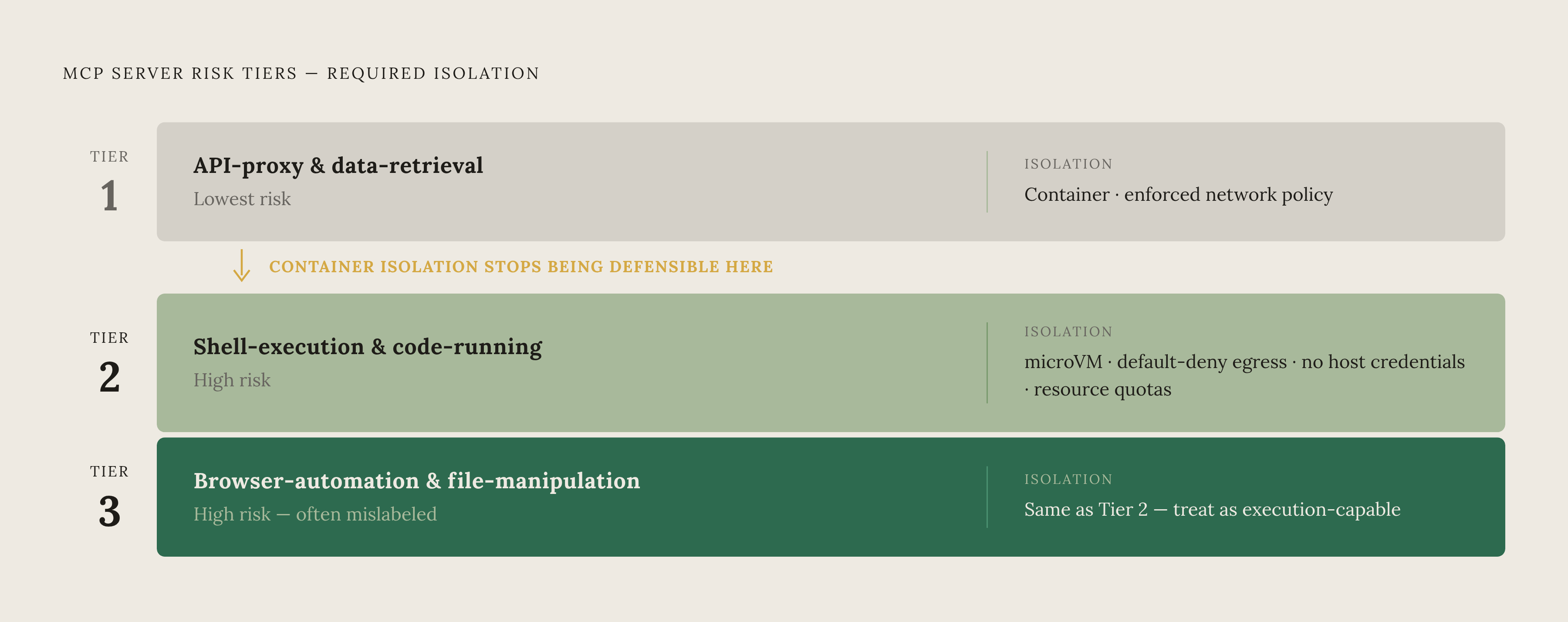
Not every MCP server needs microVM isolation. Treating maximum isolation as the default adds latency and operational cost without proportional security benefit for low-risk servers. Matching isolation technology to actual risk requires classifying the server before selecting the primitive, not retrofitting the classification afterward.
A practical framework organizes servers into three tiers, though the boundaries aren't always clean. API-proxy and data-retrieval servers, with limited filesystem access, constrained network egress to known endpoints, and scoped credentials, can often operate safely with container-level isolation if network policy is actually enforced rather than nominally configured. Shell-execution and code-running servers require microVM isolation or an equivalent kernel boundary, default-deny egress, no host credential inheritance, and resource quotas. This is where purpose-built sandboxes earn their place rather than simply adding cost. Browser-automation and file-manipulation servers should be treated as execution-capable regardless of how the server is described or named; the risk profile follows what the server can do, not what it's called.
Privilege scoping is an ongoing practice, not a one-time configuration decision. Start from the minimum set of tools and permissions the agent actually needs. The GitHub MCP server's broad tool surface is instructive as an anti-pattern precisely because it illustrates what over-provisioning looks like at the level of individual tool exposure. Rug-pull risk means teams should validate tool descriptions and behaviors at load time and monitor them for change; approval at install is insufficient because the thing that was approved may not be what's running three weeks later. Teams should scope credentials to service accounts, rotate them regularly, and never inherit them from the host environment.
Organizations beyond early pilots should treat centralized deployment as the right default rather than a complexity to defer. The pilot-to-production gap isn't closed by doing more of what worked in the pilot. It's closed by changing the infrastructure primitive and scoping that infrastructure to the actual risk each server represents. That's a harder internal conversation than "let's containerize it," but it's the one that determines whether the production deployment holds.