Firecracker vs gVisor Isolation Tradeoffs
Firecracker keeps state between invocations; gVisor trades isolation density for instant startup.
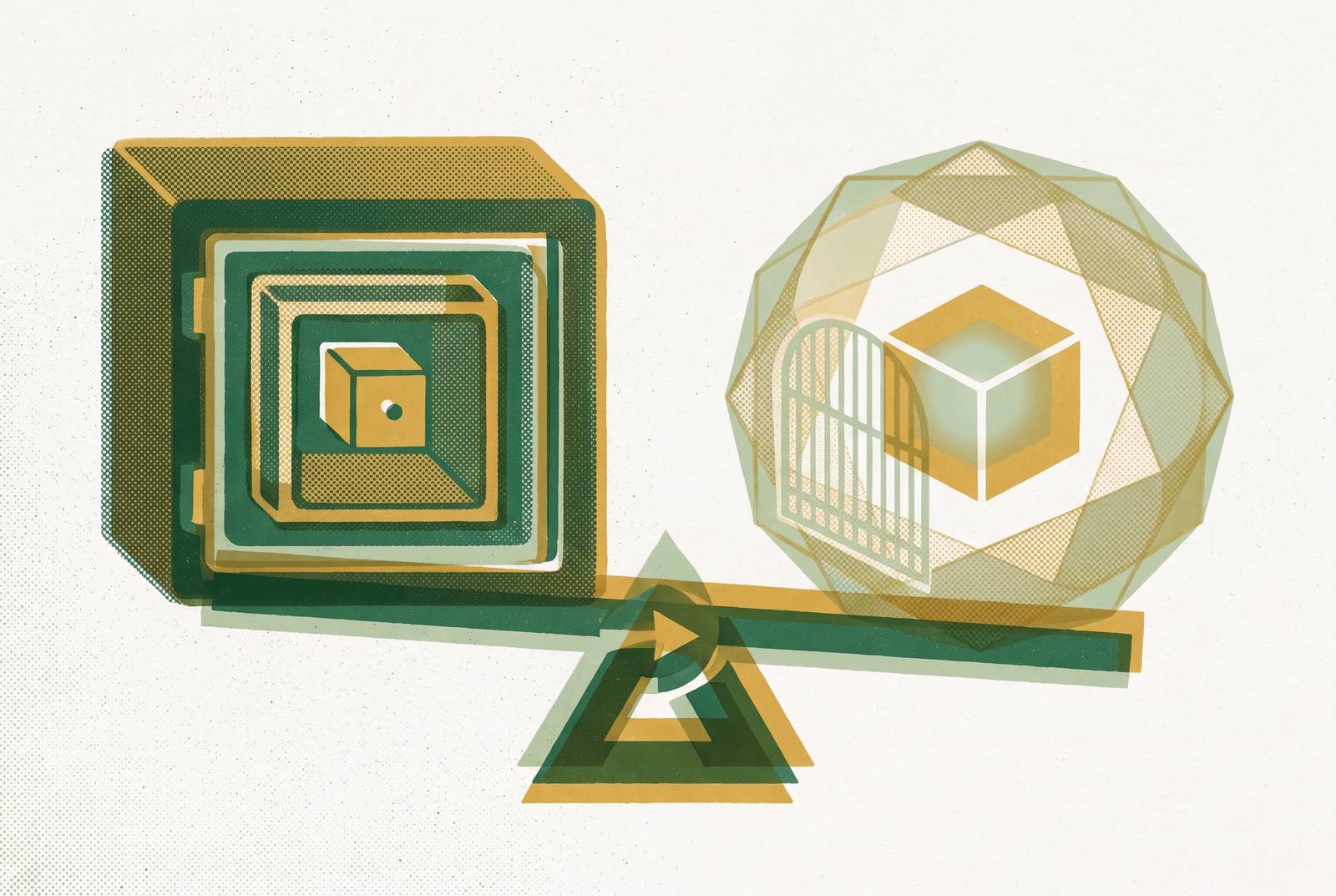
Firecracker and gVisor address the same shared-kernel risk through different mechanisms. Firecracker separates workloads with hardware-enforced VM boundaries, while gVisor intercepts system calls in userspace. Choosing between them for AI agents means tracing those mechanisms into workload compatibility, performance, state, and operating costs, rather than treating either technology’s reputation as the answer.
Why the shared-kernel problem becomes load-bearing when AI agents execute code
Standard containers isolate processes with Linux namespaces and cgroups, but those processes share the host kernel. A compromised container calls directly into that kernel, so a single exploitable syscall can give an attacker access to the host and every other workload on the node. Process separation is not a separate kernel boundary. The distinction becomes critical when the code inside the container is not code the operator has reviewed.
AI agents generate and execute code autonomously, without human review of every line. With prompt injection, typosquatted packages, and malicious build scripts, hostile input is something to expect in the workload, even if it once seemed like a rare event. Choosing a boundary to contain that code also determines performance, compatibility, compliance posture, and the burden of operating the system.
How Firecracker enforces its boundary at the hardware level
Firecracker boots a separate Linux kernel for each microVM on top of KVM. The workload calls its guest kernel, while the CPU’s virtualization features separate that guest from the host. The guest does not share the host kernel. To reach the host, an attacker must therefore cross the guest-kernel boundary and break the hypervisor, while an attacker in a container can exploit a host syscall directly.
AWS built Firecracker in Rust with a deliberately small device model, including virtio-net, virtio-balloon, virtio-block, virtio-vsock, a serial console, and a minimal keyboard controller. With fewer emulated devices, there is less code at the interface between guest and host. Firecracker runs one process per VM and further restricts that process with seccomp, namespaces, and cgroups. AWS Lambda and AWS Fargate use this architecture in production, but its defining property is structural rather than reputational, namely a separate guest kernel behind a hardware boundary.
How gVisor enforces its boundary in userspace
Google’s gVisor places a userspace kernel, called the Sentry, between the workload and the host. The Sentry intercepts application syscalls and re-implements the Linux syscall surface in Go, rather than passing those calls directly to the host kernel. A second process, the Gofer, mediates host-side filesystem access. The Sentry itself runs unprivileged under heavy seccomp filtering. This substitutes a tightly restricted software intermediary for direct access to the host’s broad syscall surface.
The implementation also has several tuning options. Systrap uses seccomp for syscall interception, while the KVM mode uses virtualization for syscall isolation on bare metal. Directfs is a filesystem-access feature for faster file operations. Those distinctions do not make gVisor a separate-guest-kernel architecture like Firecracker. The host kernel remains shared, and a vulnerability reachable through the Sentry’s allowed syscalls remains reachable in principle.
Google Cloud Run and GKE Sandbox use gVisor. It ships as the OCI runtime runsc and fits behind a Kubernetes RuntimeClass, allowing a pod to opt in with one field while retaining normal images, volumes, and kubectl workflows. That is a different kind of architectural advantage. It places a substantial barrier in front of the host kernel without making the operator manage a guest kernel for every sandbox.
Where the mechanism difference shows up in cold start, density, and syscall overhead
The two mechanisms put their costs in different places. Firecracker pays at boot and in per-VM memory because it launches a real kernel. Cold start is fast, but it is not instantaneous. Once the VM is running, the guest kernel handles syscalls without userspace interception, giving Firecracker near-native syscall performance. Small per-microVM overhead makes high VM counts practical, although startup remains a cost that short tasks must absorb.
gVisor starts processes without booting a guest kernel, so it can support high sandbox density. Compute-heavy, syscall-light work sees modest overhead, while I/O-heavy work pays repeatedly for interception and emulation. Agents compiling code or streaming tool output can therefore behave quite differently from agents spending most of their time in computation. The useful comparison is not simply which sandbox starts faster, but how often the workload crosses its mediated interface.
Execution modes and filesystem options can change that balance, so the workload remains the proper unit of comparison. Density also cannot be inferred from one memory-overhead figure alone. For AI inference, GPU access is another differentiator, separate from CPU and syscall performance. Teams need to check whether a runtime supports the device-access needs of a workload, since its general performance profile does not tell them that.
The compatibility gap that gVisor's syscall re-implementation creates
Re-implementing Linux introduces a compatibility obligation that running Linux does not. When an application needs a kernel feature that gVisor has yet to implement, it may behave differently, run more slowly, or fail. Relevant constraints include ptrace, BPF, and some FUSE filesystems. Raw sockets are disabled by default and require opting in with the --net-raw flag. These distinct limitations persist even with more compute.
When an agent installs arbitrary packages, compatibility also depends on what is in the dependency tree. A public-registry pip install can bring in a package whose post-install hook depends on an unsupported syscall. Firecracker’s real Linux kernel offers broad workload compatibility, but shifts the constraint to the host. It needs Linux with KVM access, either on bare metal or on a VM instance that provides it. Nested virtualization is not officially supported or validated by Firecracker, even though running inside a cloud VM can be viable when that VM exposes KVM access.
How Firecracker's snapshot-restore mechanism enables stateful, long-running agents
With a separate guest kernel, Firecracker can keep execution state within one boundary. Its snapshot-restore API lets operators prepare a microVM, snapshot memory and block-device state, and restore later sandboxes, bypassing a fresh boot. This changes more than the startup path. An agent that needs to resume running processes has to keep more than its source files or installed packages. The guest boundary makes kernel and memory state part of the same resumable environment.
AWS AgentCore illustrates the session model built around that continuity. AWS shipped the managed AgentCore Runtime on September 18, 2026, with sessions identified by a runtimeSessionId. Subsequent invocations using the same identifier route to the same microVM, preserving in-memory state. That makes the execution environment part of the session. It supports work that cannot be treated as a succession of unrelated, disposable tool calls.
Perplexity’s SPACE provides another example of task-specific Firecracker microVMs. Perplexity open-sourced SPACE in October 2026 as an Apache 2.0 Rust codebase, and reported substantially lower median sandbox creation latency than its previous provider. gVisor has counterparts in managed environments, including GKE pod snapshots for faster resume. The asymmetry is in the surrounding tooling. Branching, forking, and long-running stateful sessions have a more mature ecosystem on the Firecracker side.
What the isolation mechanism means for security posture and blast radius
If hostile code has root inside a sandbox, what boundary remains between it and a neighboring tenant? In Firecracker, that boundary includes the CPU’s virtualization layer separating the guest from the host. In gVisor, the application’s calls remain mediated by the Sentry, which is itself an unprivileged, restricted userspace process. Compromising the application does not by itself remove that intermediary.
If the Sentry is also compromised, however, the remaining host-kernel exposure is the syscall set that process is allowed to use. A reachable kernel vulnerability can then threaten other tenants on the node. gVisor substantially reduces exposure compared with plain containers, but its second barrier is software rather than a dedicated guest kernel behind hardware virtualization.
Perplexity’s SPACE red-team results distinguish VM containment from network containment. In tests across 9 frontier models, 0 of the 108 attempts to make a VM-to-host escape succeeded. Before egress fixes, agents bypassed egress policy in 11 of 54 partial-network runs, falling to 0 after fixes. Those results provide evidence specific to the tested conditions. They also show why egress filtering, per-tenant traffic attribution, and network policy remain separate responsibilities whichever runtime is selected.
The operational complexity Firecracker's mechanism imposes on self-built stacks
Firecracker supplies an isolation primitive. A self-built stack needs a guest kernel, root filesystem, networking, and lifecycle management, including manual management of TAP interfaces and iptables. By contrast, gVisor’s OCI integration leaves much of the existing Kubernetes operating model intact. A team may gain meaningful isolation without taking ownership of a new VM-management layer.
Kata Containers offers a middle path for teams seeking hardware-level isolation with Kubernetes-native orchestration. Firecracker is one of its supported backends. That option separates the desire for a VM boundary from the decision to manage Firecracker directly. It changes where some of the engineering work of platform operations sits.
SOC 2 Type II or ISO 27001 requires observability and evidence collection that can cross the VM boundary without weakening isolation. Instrumentation cannot simply be added at audit time. SOC 2 Type II evaluates operating effectiveness over a multi-month window, so controls must have been operating throughout that period. Strong containment provides a foundation for that work.
A decision framework based on mechanism, not reputation
A team should choose Firecracker when genuinely untrusted, multi-tenant execution requires a hardware boundary, especially for customer-supplied code, AI-generated code, and arbitrary package installs. Long-running stateful agents strengthen that case when snapshot-restore and session continuity are architectural requirements. Syscall-heavy work is another reason to choose it for speed. The condition is that the team can build the surrounding platform or adopt one that supplies it.
Compliance can add to that case when a deployment needs a boundary that hardware enforces and an audit can check. It does not turn the runtime into compliance by itself. For GPU-dependent ML workloads, teams also need to check device-access support as well as decide on isolation. These needs rule out some architectures before startup speed or sandbox density can decide between those that remain.
A team should choose gVisor when it wants better container security with as little change as possible to how it runs containers. It also fits environments without KVM access and teams that run many short-lived, container-shaped tool calls whose syscall needs are known to fit what it supports. Compute-heavy, syscall-light workloads suit its overhead profile. Where Kubernetes integration and hardware isolation are both requirements, Kata is a credible alternative to operating Firecracker directly.
The gVisor team’s April 2026 MAGI demonstration applied this model to AI agents using OpenClaw. Its September 2026 follow-up extended MAGI to a full GNOME Linux desktop through an MCP server and OpenClaw, with a virtual mouse and keyboard. That concrete computer-use-agent example demonstrates compatibility for a particular environment while leaving other workloads to be assessed on their own requirements. Both runtimes are Apache 2.0 open-source, so teams can look at how each one works when making their choice.
What purpose-built agent infrastructure adds on top of either runtime
Reliable production execution also needs networking, session management, lifecycle orchestration, observability, and compliance logging, with snapshot-restore where state continuity requires it. Firecracker-based platforms can combine stateful execution, Docker-native workflows, and enterprise compliance support without requiring each agent team to build the full operating layer.
A team may instead extend its Kubernetes stack with gVisor, adopt VM-based orchestration, or build directly on Firecracker when its requirements justify the engineering cost. Production teams must choose an isolation mechanism that fits the workload and decide who will operate the platform around it.